
🚀 My impact
By experimenting and optimising the PDP entry experiences starting in April 2025, the LPO initiative delivered a measurable uplift across key business KPIs by June 2026.
OP 2025 delivered:
• BR: -5%
• CVR: +4%
• GMV: 9M EUR
OP 2026 delivered
• BR: -8%
• CVR: +4%
• GMV: 16M EUR (June 2026)
Background
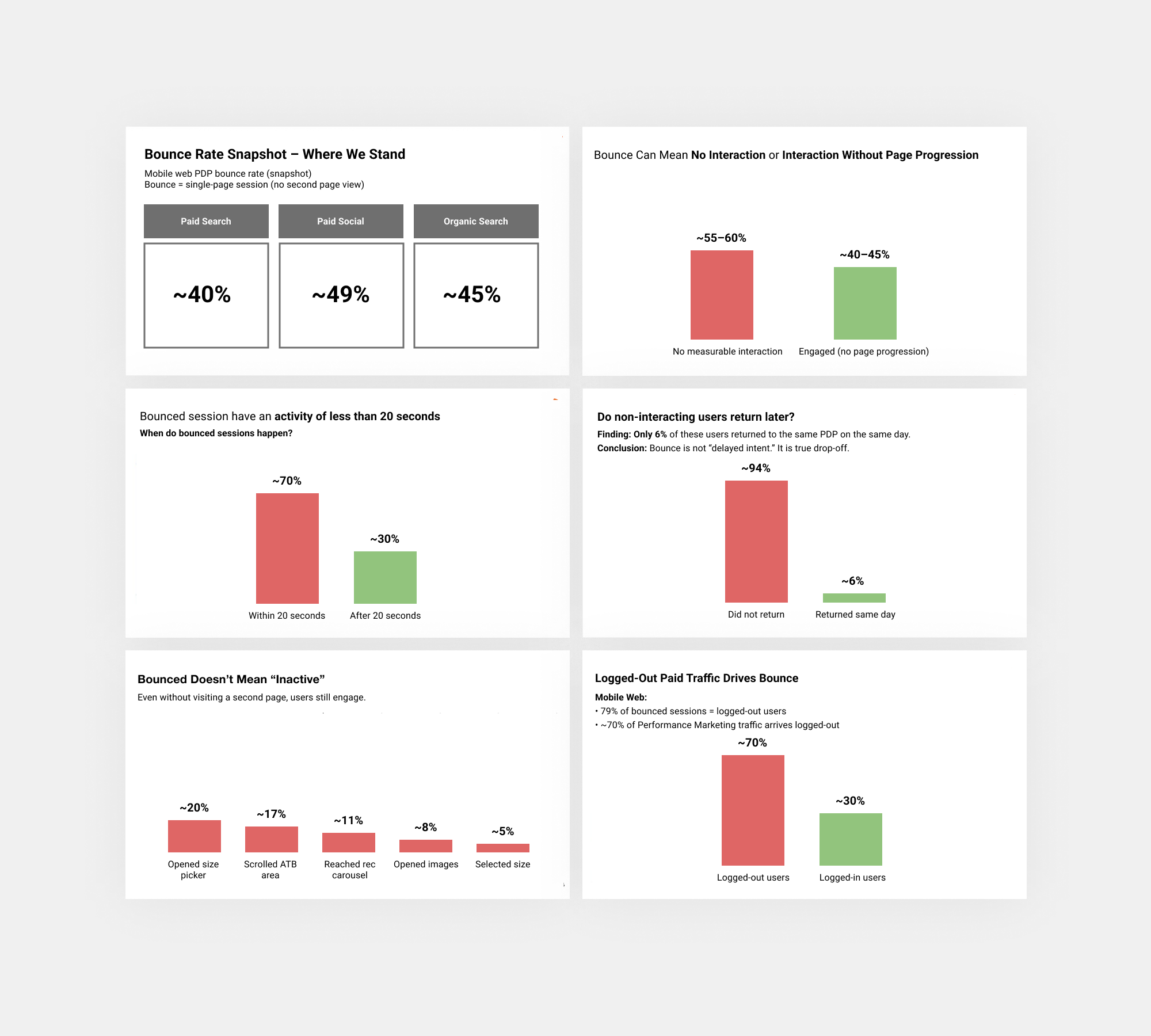
Zalando data showed a clear mismatch at PDP and Catalog entry points: Performance Marketing and SEO users often bounced immediately, with PDP bounce rates around 50% and Meta above 56%. Around half of PDP entry sessions came from Performance Marketing, mostly logged-out users landing on pages that did not match their search intent.
The Challenge
Align PDP landings with logged-out paid traffic, removing friction to reduce bounce and increase CVR and GMV.
Role
AI-driven Lead Product Designer.
I led the bundle strategy and CRO experimentation at Zalando, applying a data-driven product design approach to reduce friction and improve conversion at scale for paid traffic landing on PDP (SEA and Meta) on mobile web, while laying the foundation for personalised design architecture in 2026.
• AI-Powered UX Designer
• Systems Thinking Designer
Deliverables
• Consolidated experiment Roadmap LPO initiatives 2025 and 2026 (influenced its definition)
• UX strategy initiatives 2026 (influenced its definition)
• Strategic Design Bundles for the PDP
• EDD (Experiment Design Document) for each bundle
• Defining KPIs per bundle and setting up control vs. variant experiments
• A11y documentation: Dark mode, Landscape view, 200 % Dynamic text, Screenreader annotations.
• Workshops with Meta and internal workshops on bundle prioritisation and ideation
• UAT and QA documentation evaluating functional performance, design, error-handling logic, and A11y compliance
• Creation of the holdout group approach (influenced its definition)
Tools
Figma, Figma AI, Figma Make, Miro AI, Chat GPT 5.1, Gemini 2.5, Claude, Attention insight, Github, Eppo to run experiments, BigQuery data from Curated Base Table (CBT), Synapse internal data tool.
Final UI
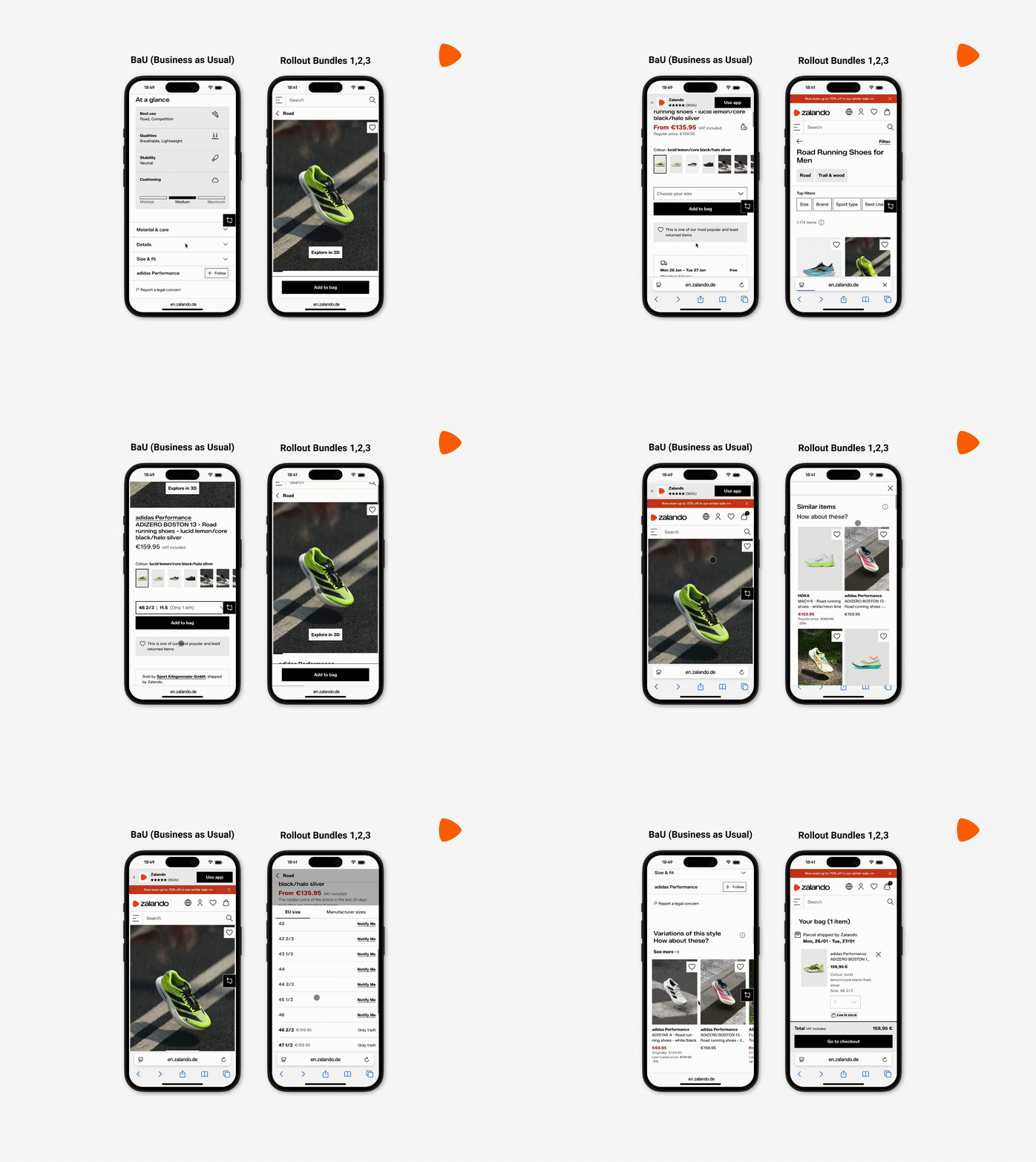
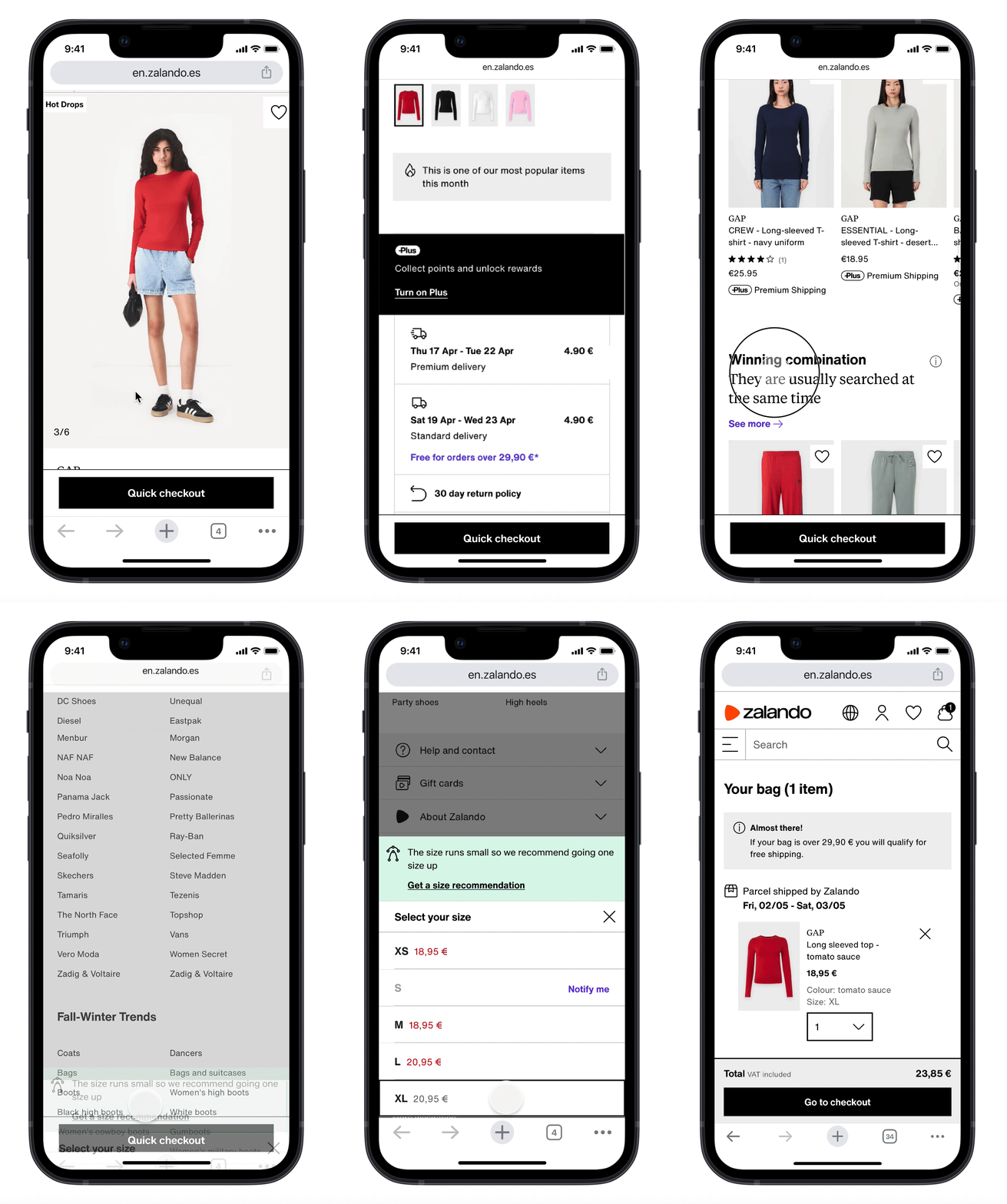
This UI reflects the consolidated rollout of Bundles 1, 2, and 3, aligned with the broader Zalando brand refresh.
✅ UX Strategy
When I joined Zalando in April 2025, the vision for the Performance Marketing Channel — including the why and what — as part of the strategy had already been defined through Google/Meta workshops Baymard audit and and internal prioritisation.
With information scattered across different PDFs, I used ✦ Claude Opus 4.5 to generate a simplified matrix showing Goals, Vision, and Objectives for the LPO project
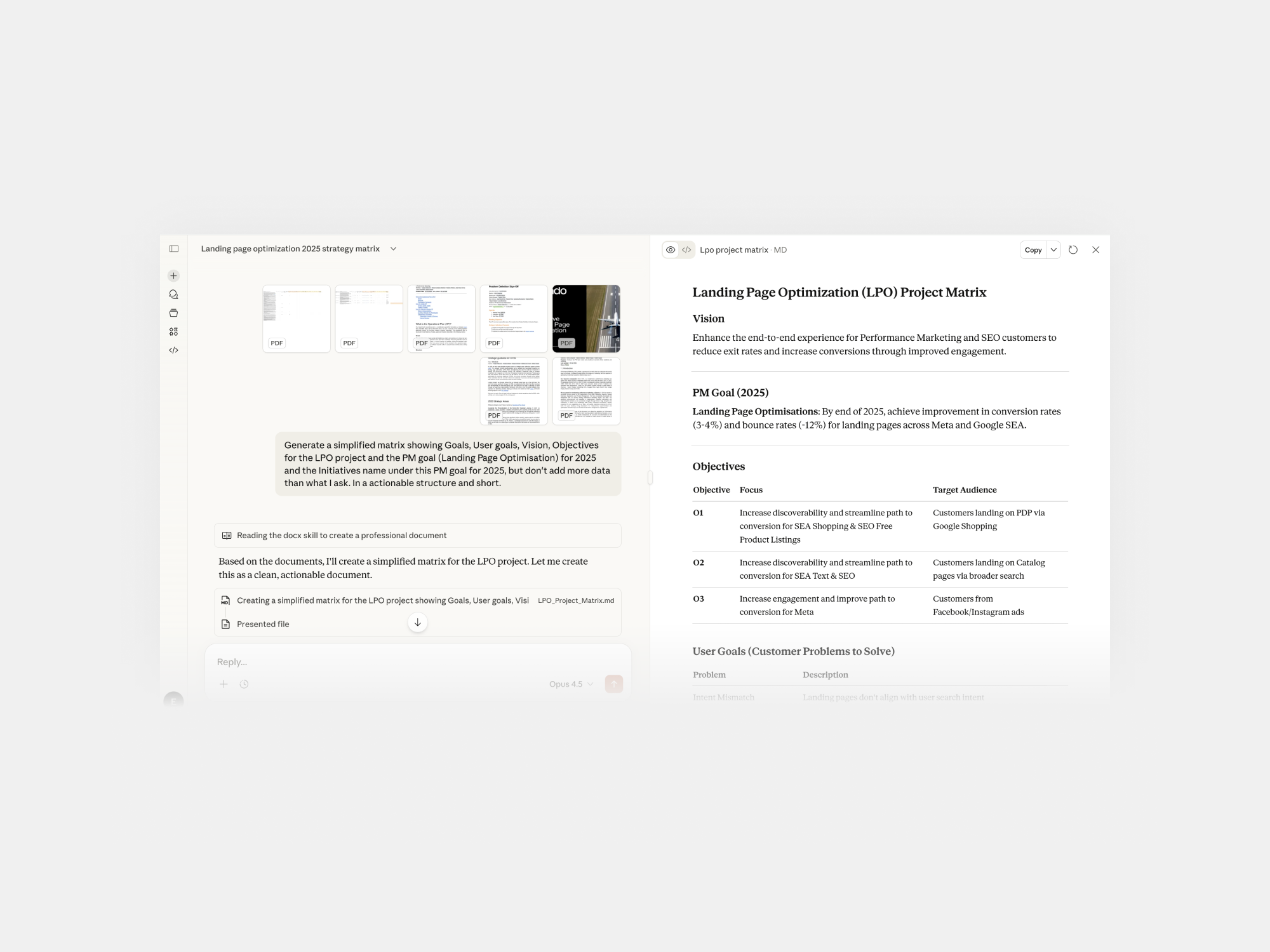
Goals LPO project
So I translated that in a understandable structure after reviewing it with the PM and the Head of Design.
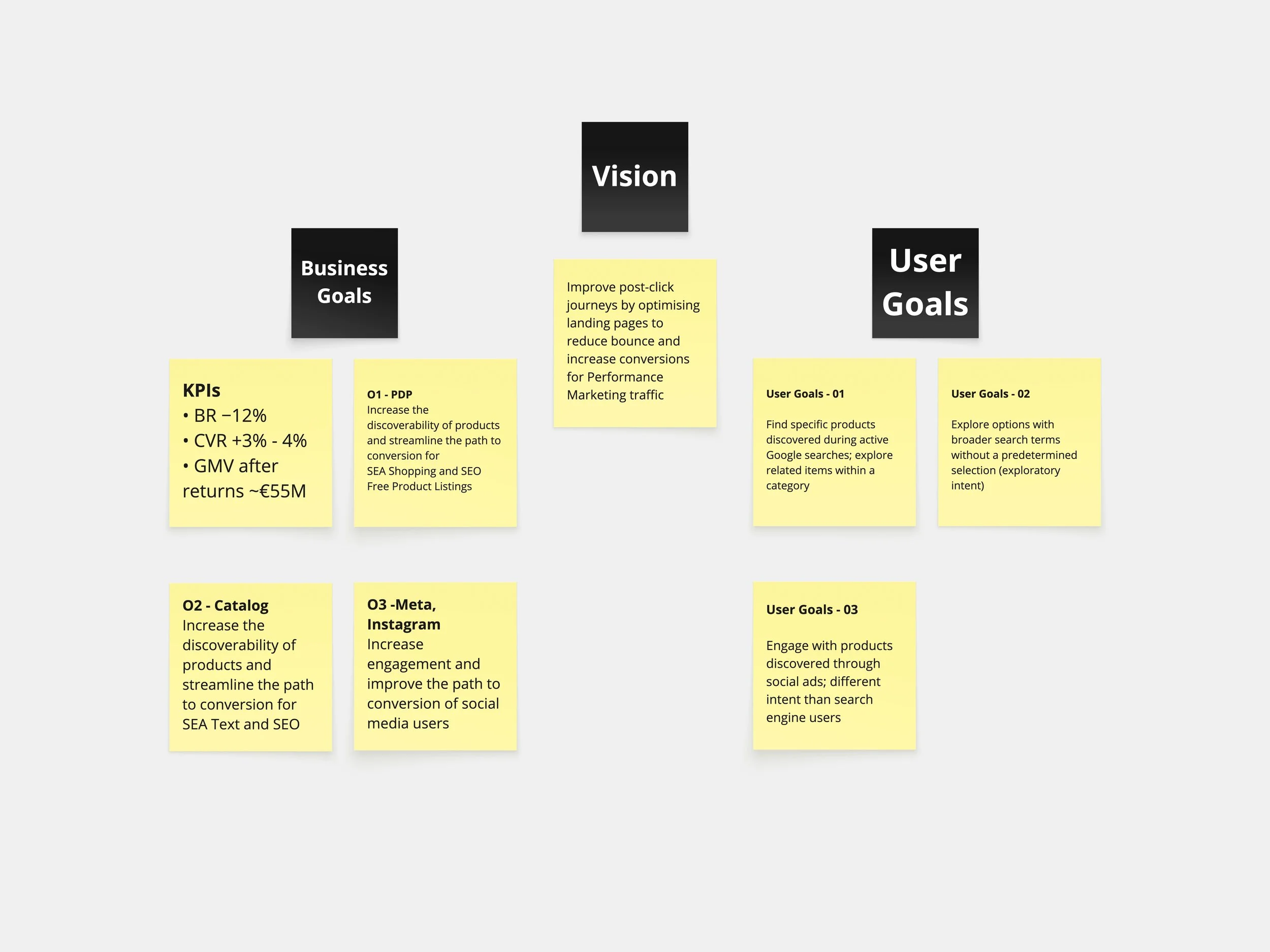
We had to re-prioritise along the way. After reviewing initial KPI estimates with Analytics, we recalibrated the end of 2026 goals to –8% BR, +4% CVR, and ~€45M GMV. Due to a potential cloaking risk, SEO traffic was excluded from experiments, which removed Catalog tests and shifted focus to PDP experiments using paid traffic only. Goals were recalculated accordingly.
• Goals to initiatives 2025
For 2025, targets were BR −5%, CVR +4%, and ~€10M GMV, adjusted after cancelling SEO catalog tests. The roadmap evolved from three initial bundle hypotheses, iterating on learnings and constraints, while future bundles were designed to enable 2026 personalisation. Impact was estimated using historical CRO benchmarks, traffic data, and Baymard insights.
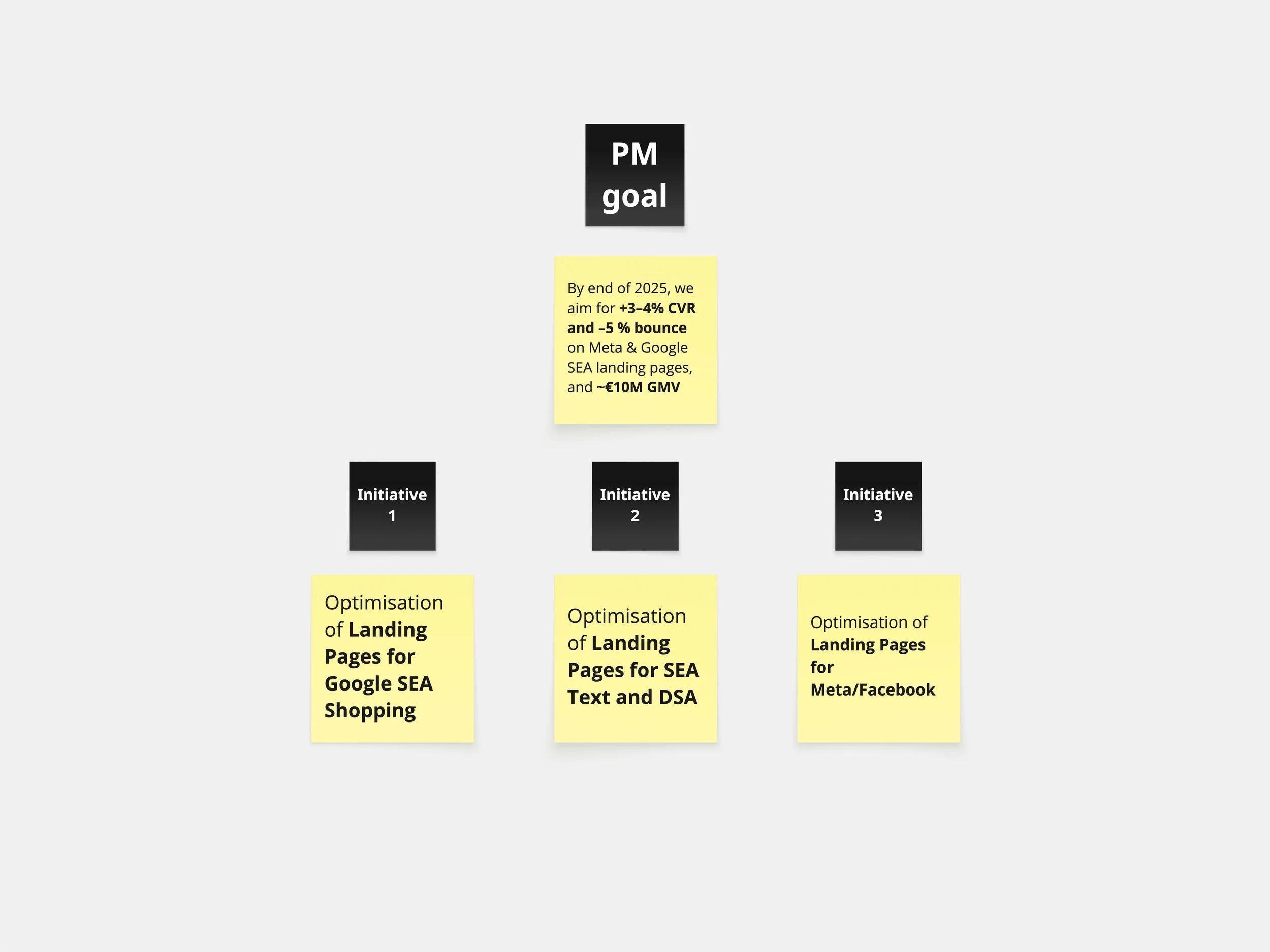
The how and when were still to be defined, meaning the next step was to lay out the execution plan and timeline for delivering the strategy. With financial pressure to deliver impact quickly, I accelerated Bundles 1–3 by prioritising bounce-rate reduction, recognising that lowering early drop-off was the necessary first step to unlock conversion and GMV uplift.
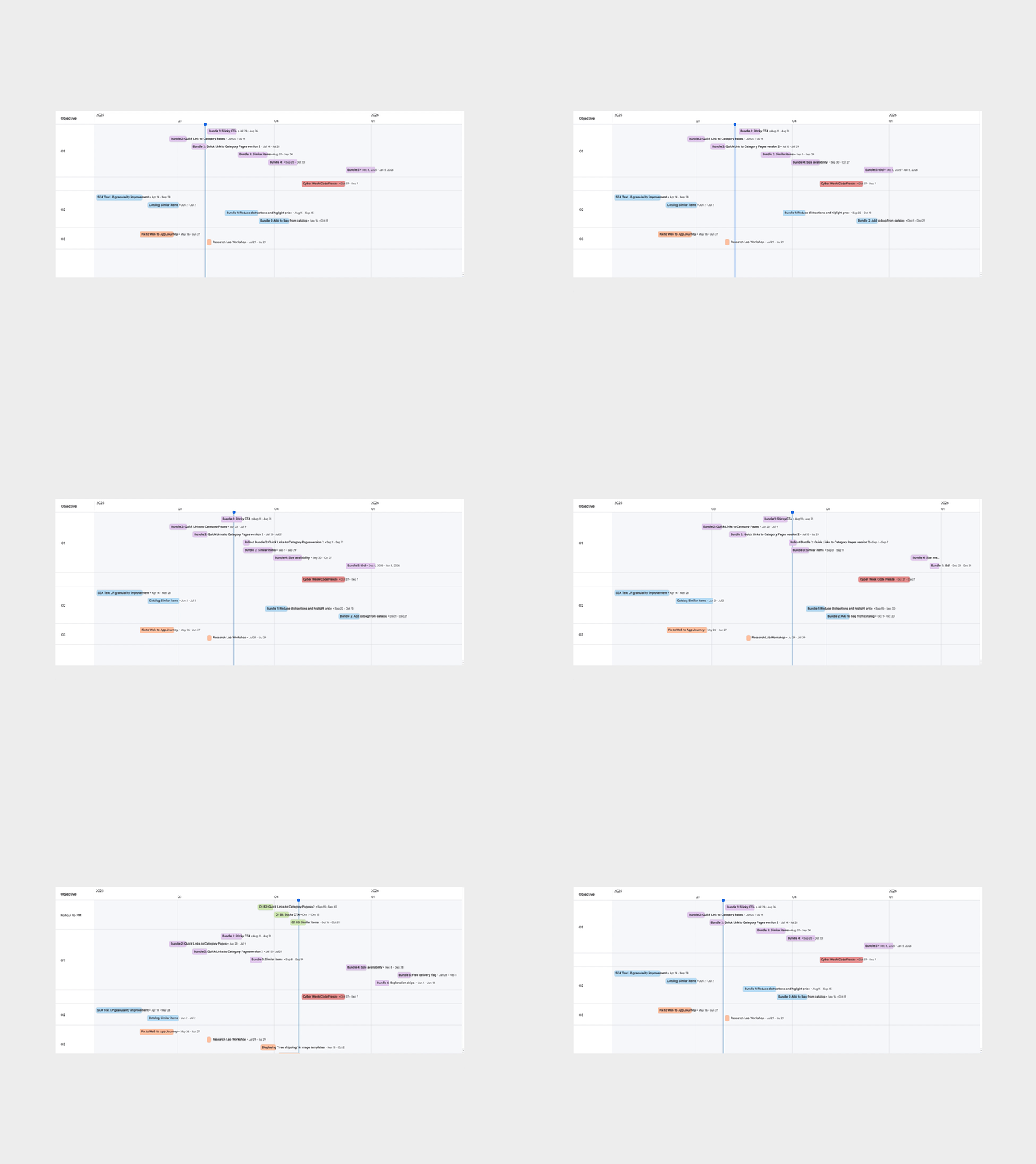
• Goals to initiatives 2026
So around October 2025 we started to create the OP planning 2026.
I co-led a workshop with a PM focused on hypothesis definition and initiative grouping for end-to-end customer journey OP planning, helping structure early thinking and opportunity areas using insights from Google and Meta workshops and 2025 data.
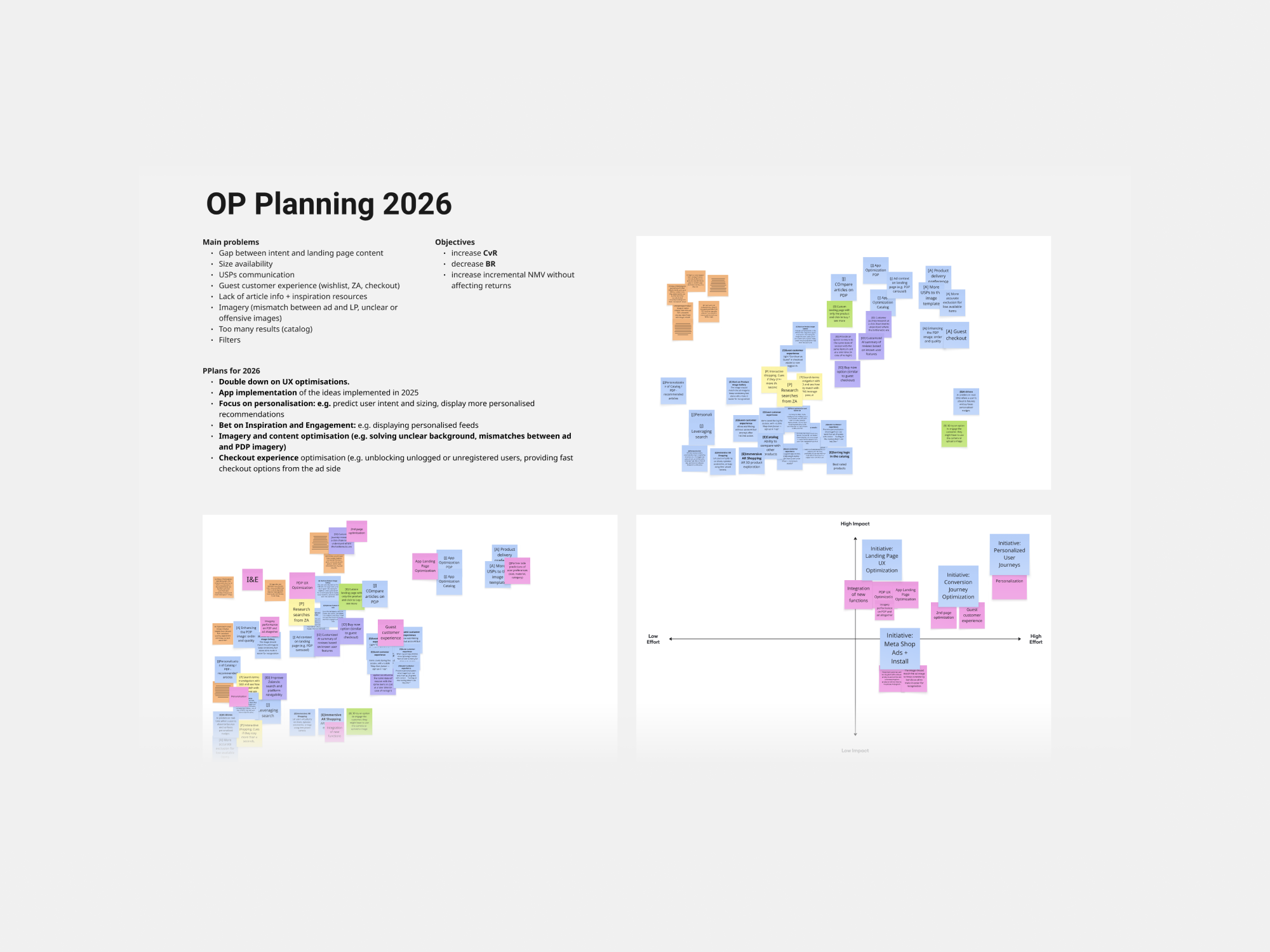
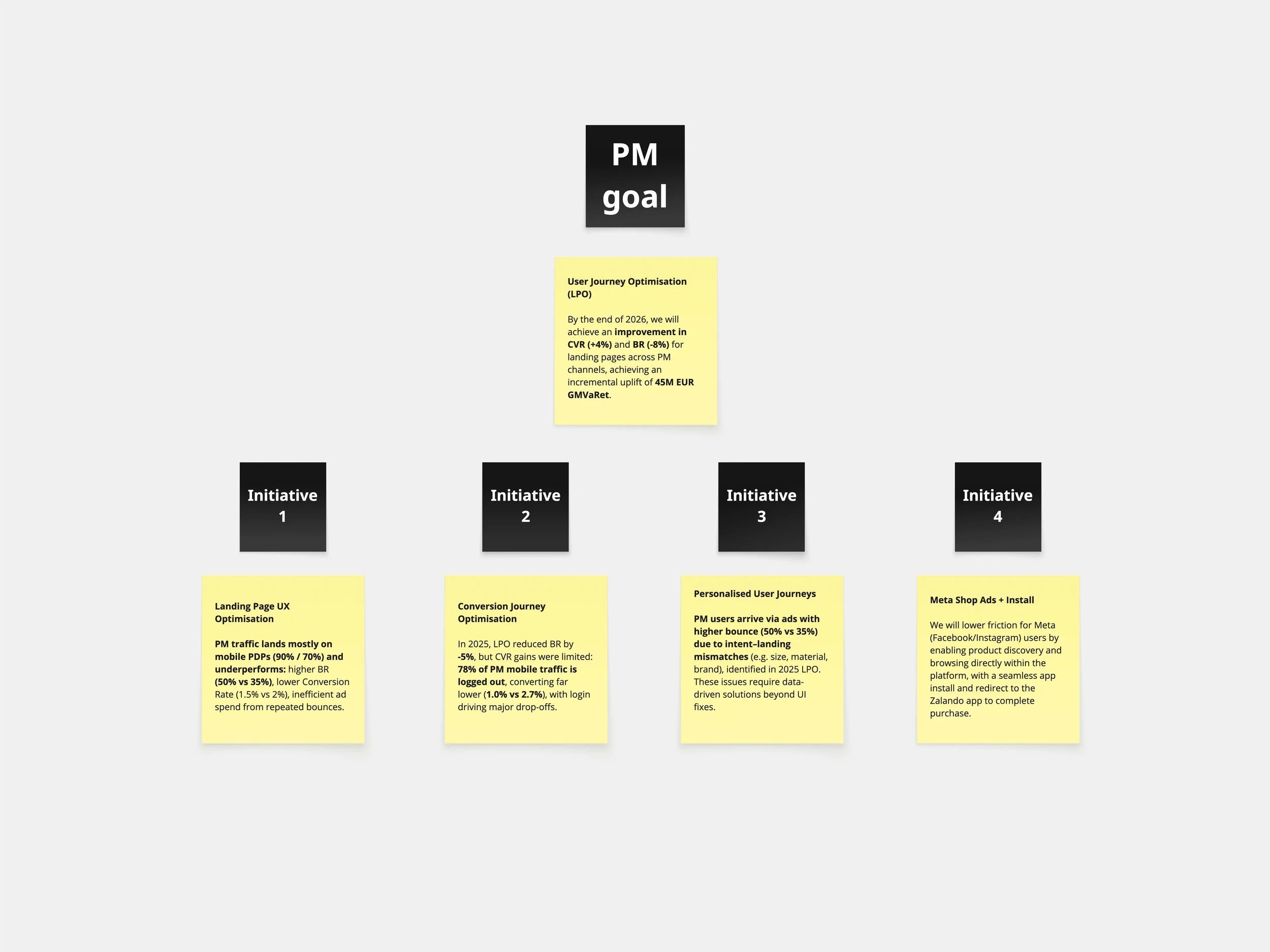
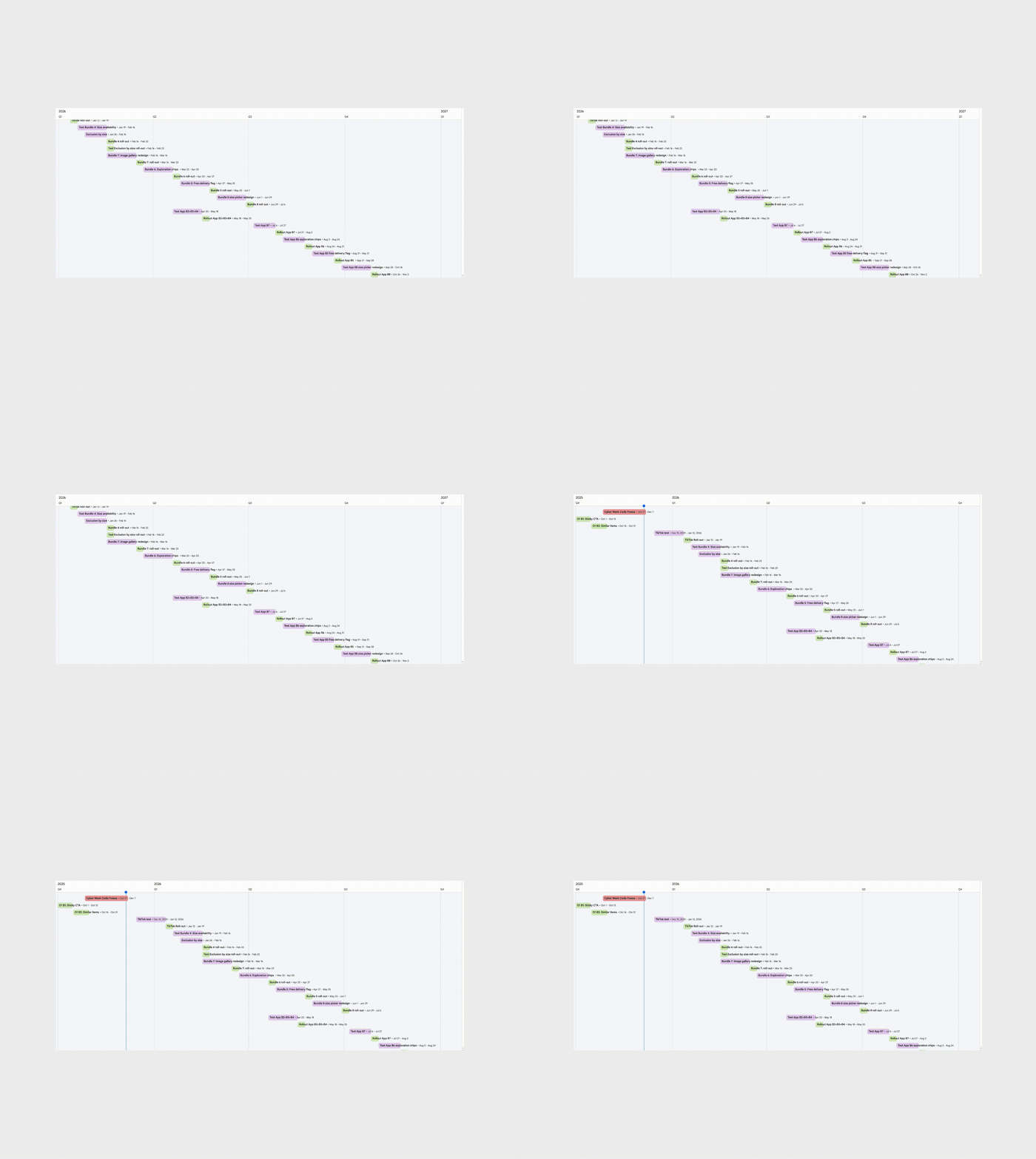
Around November 2025, we consolidated the 2026 roadmap by carrying over approved but unshipped Bundles (4–7), prioritised by BR and CVR impact and kept as a flexible backlog, while assessing their applicability to the native app.
✅ Empathise
• Data analysis and quantitative research
At Zalando, we didn’t have Hotjar or similar behaviour-tracking tools, but we did have internal analytics. I collaborated closely with the analytics team to analyse the data in the sheets
To prepare for ideation, we compiled the key insights regarding the BR PDP into a Google Slides deck so the team could align on what mattered most
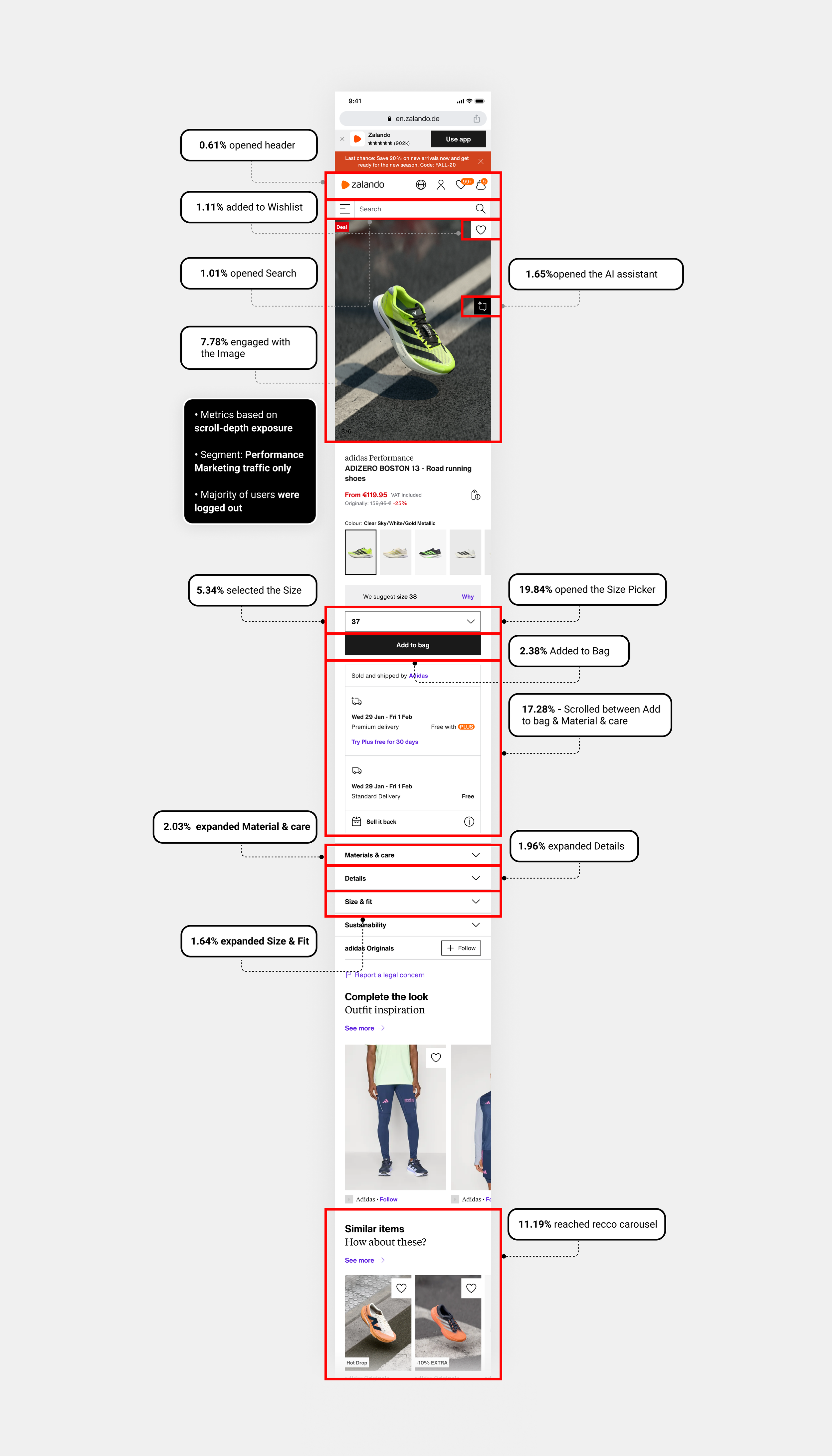
So I analysed the interactions before the user bounce across the key areas of the PDP.
• Qualitative Research
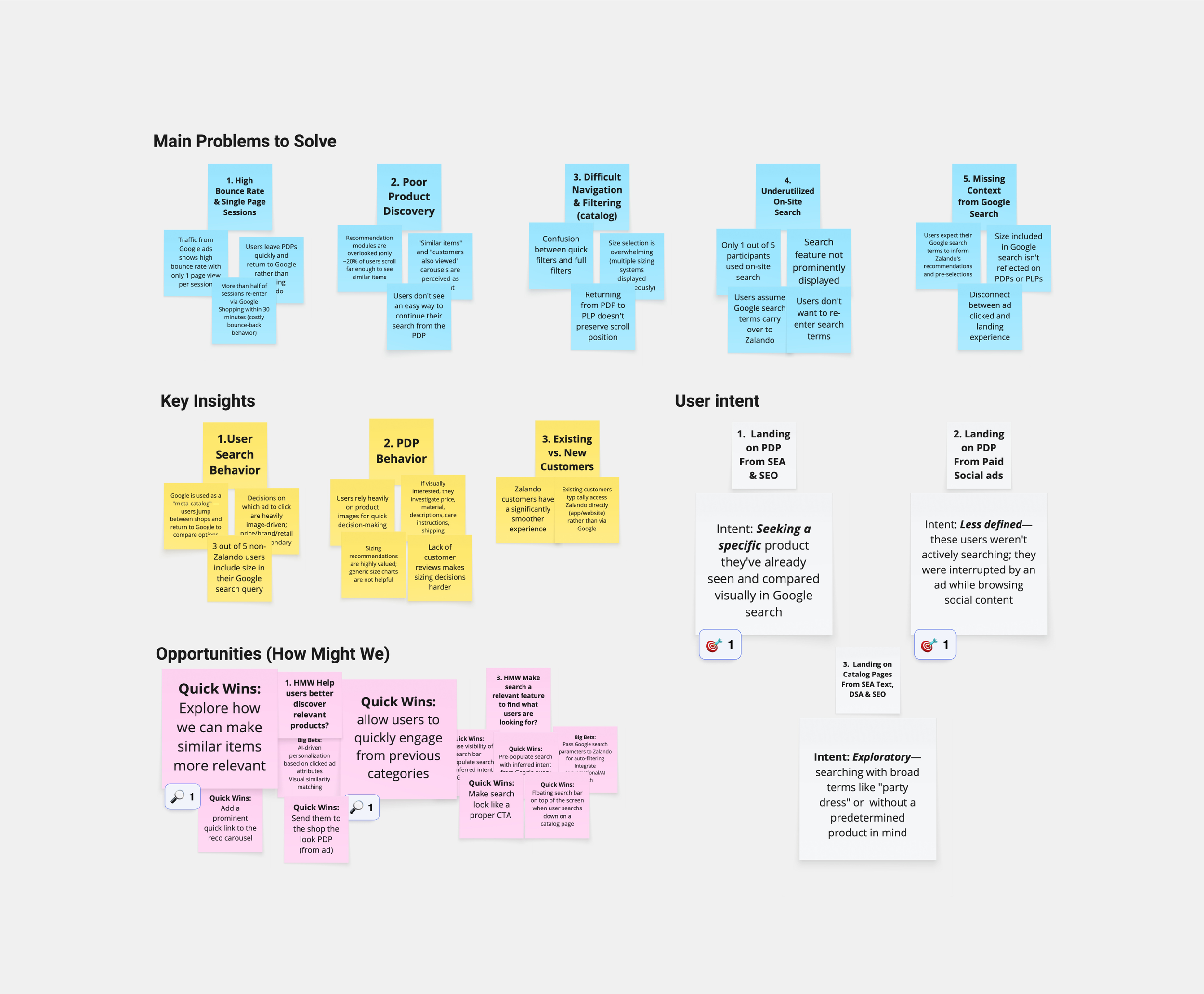
We already had solid research from Google’s mobile lab and prior interviews. I focused on extracting key insights—understanding user intent when landing on the PDP and identifying the main problems. Some proposals emerged from this workshop, but I re-evaluated them when I joined the company.
✅ Define
User: Users landing from Performance Marketing channels (SEA, Meta) arrive with an intent to either explore or purchase, expecting relevant products, easy discovery and a fast path to decision.
Needs: They need landing experiences that match their search intent, surface similar alternatives effortlessly, provide enough information to evaluate options, and minimise friction when continuing the journey or deciding to buy.
Insights: Research and analytics show high bounce rates, repeated return to Google/Meta, and friction in discovery flows — indicating that current PDP page often fail to meet intent quickly or support confident product exploration, resulting in drop-off before conversion.
• Holdout group set up and approach
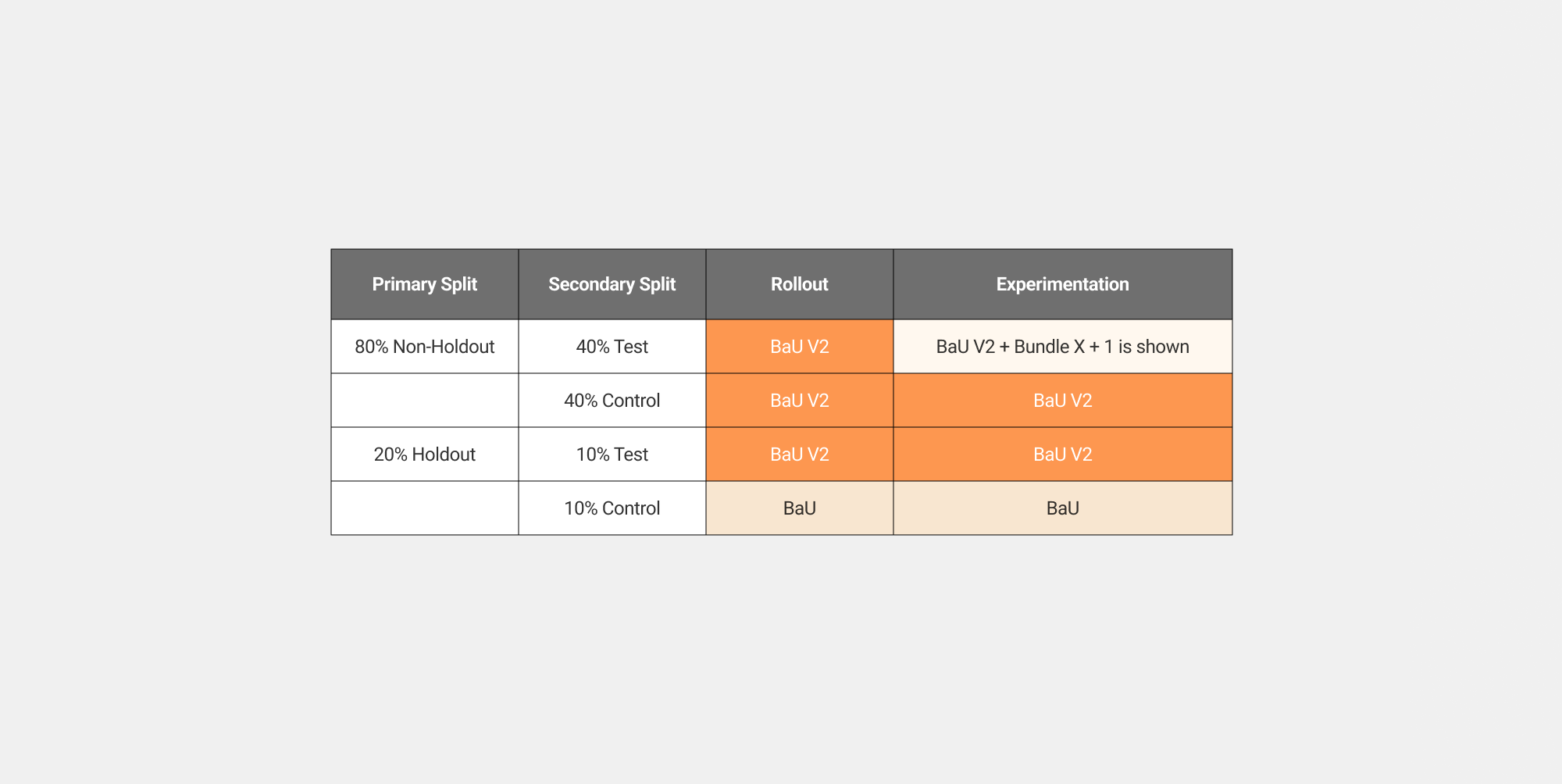
We created a holdout group to maintain a clean baseline and accurately measure the incremental impact of our experiments.
Holdout setup & measurement approach
• Holdout group created to preserve a clean BaU baseline
• Holdout traffic excluded from LPO experimentation and feature exposure
• Purpose: measure true incremental impact over time
✅ Ideation Bundle 1-3 strategy
With financial pressure to deliver impact by August 2025, the approach was to explore Bundles 1, 2, and 3 in parallel to validate their potential impact and accelerate the creation of the roadmap—clarifying which bundle should be prioritised and run first based on expected impact.
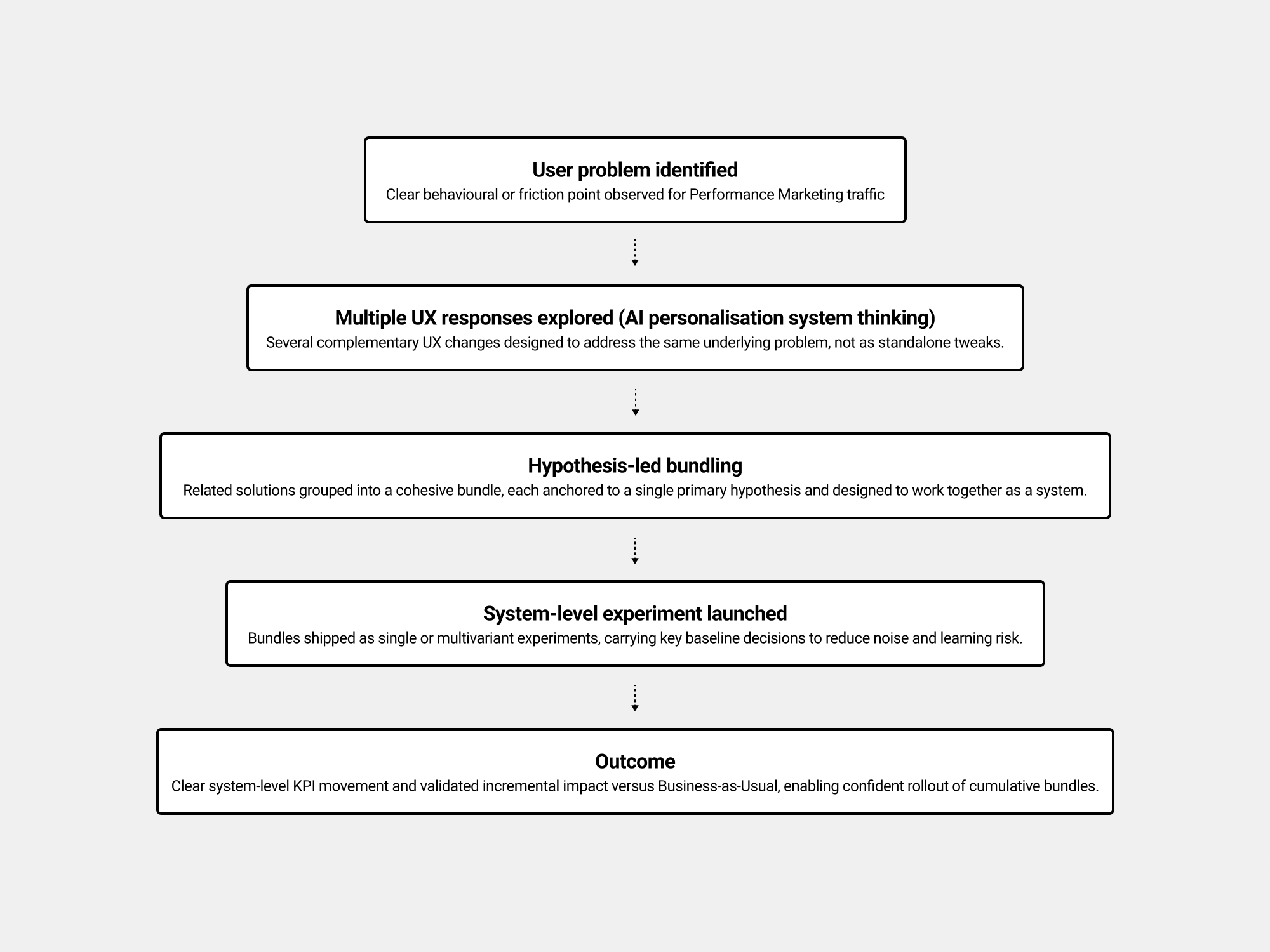
• Bundle Strategy framework
I optimised the PDP as a system, assessing scalable solutions for Performance Marketing and their potential to scale to the wider Zalando audience.
• Hypothesis generation
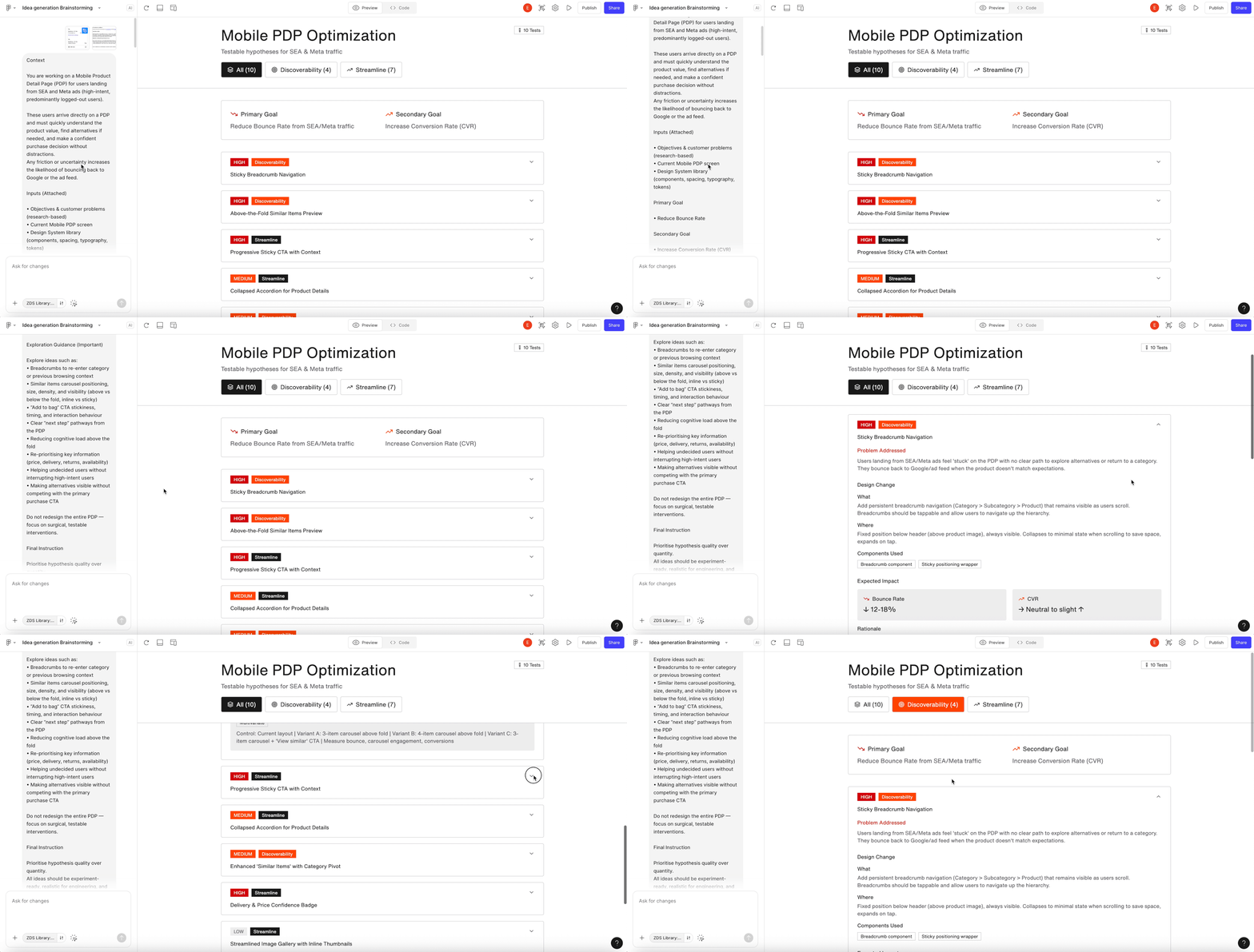
While the Google workshop helped identify quick wins and high-impact opportunities, my focus was on validating hypotheses through early feedback.
I used ✦ Figma Make as a thinking accelerator to explore directions rapidly - prioritising speed over polish to initiate design conversations.
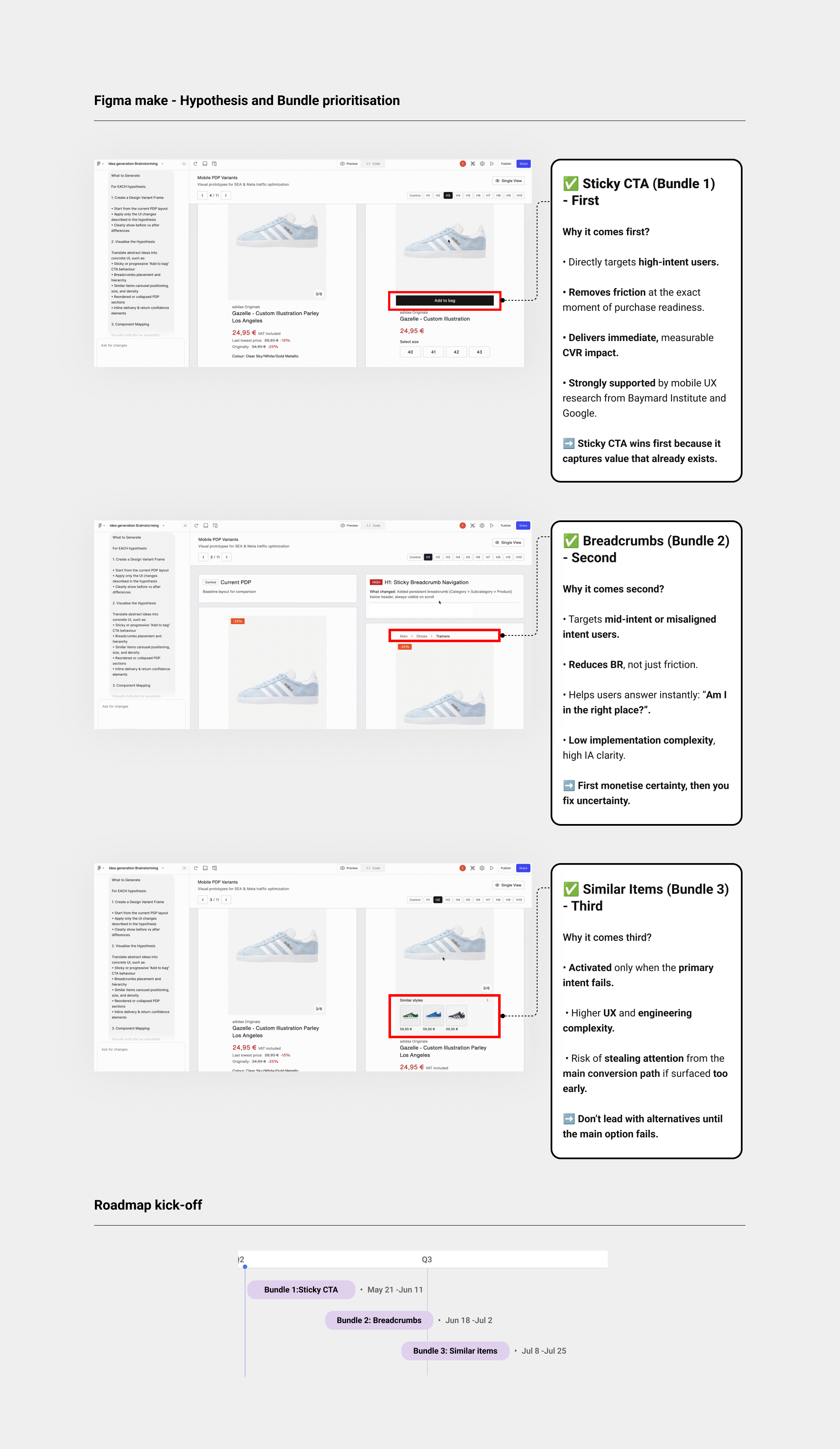
After rapid hypothesis generation in Figma make, I aligned with the PM and lead engineer to prioritise PDP improvements by impact and feasibility, informed by Baymard report and Google research—sequencing Sticky CTA, Breadcrumbs, and Similar Items into Bundles 1–3 on the roadmap.
Bundle 1 (Sticky CTA)
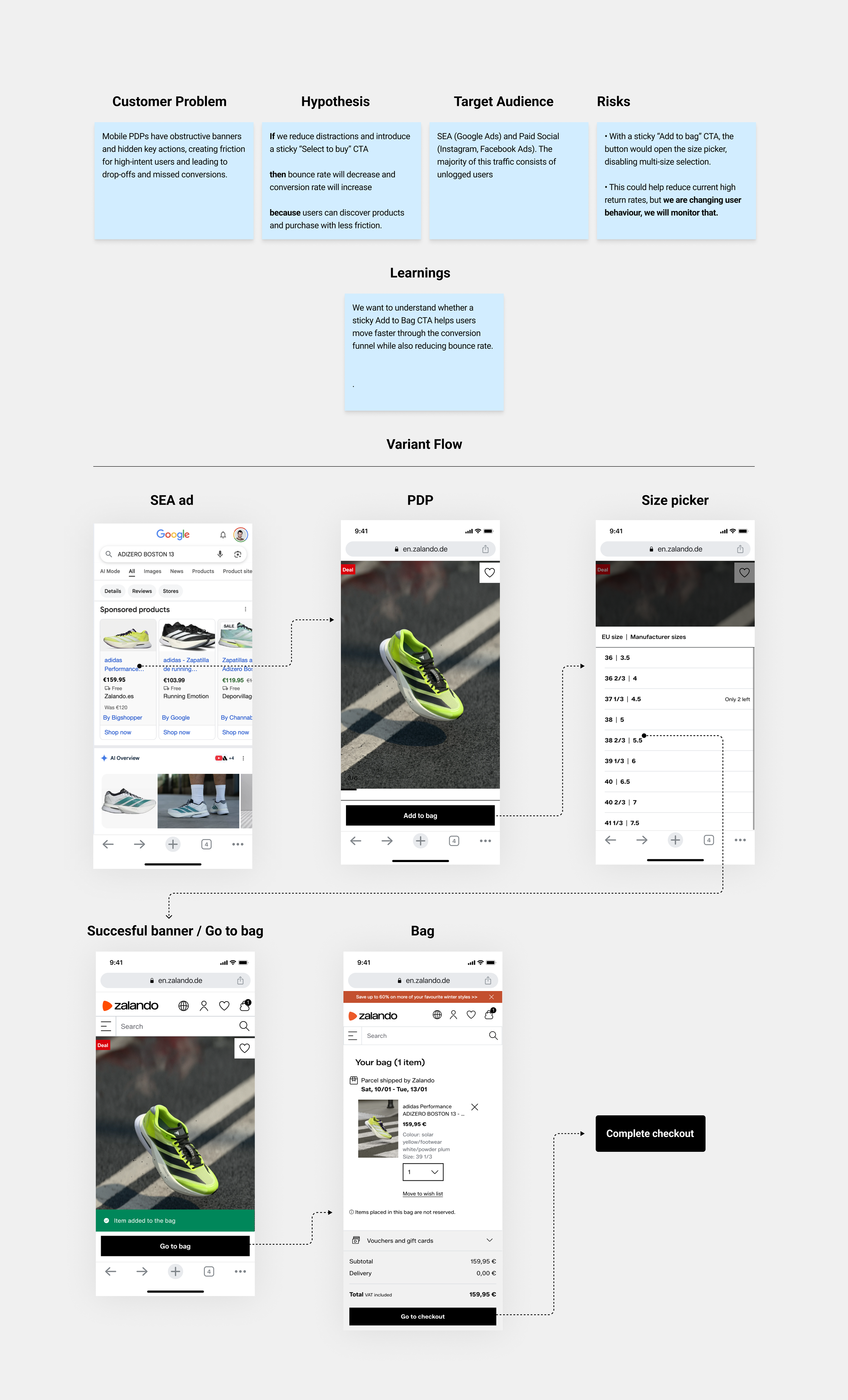
For Bundle 1, I focused on a clear learning objective: understanding how quickly we could move users through the conversion funnel when they land on the PDP from SEA and Meta channels.
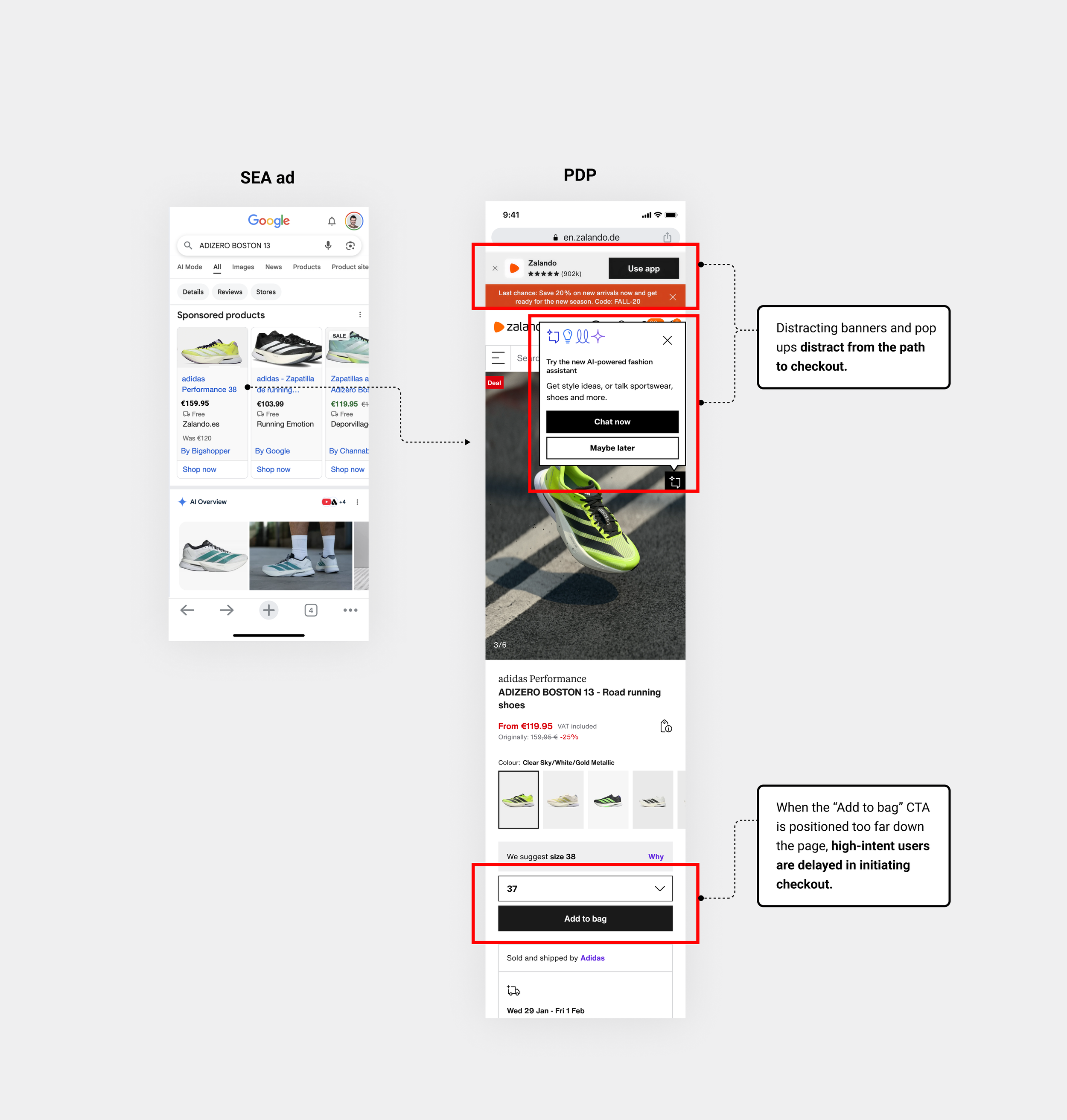
• Context
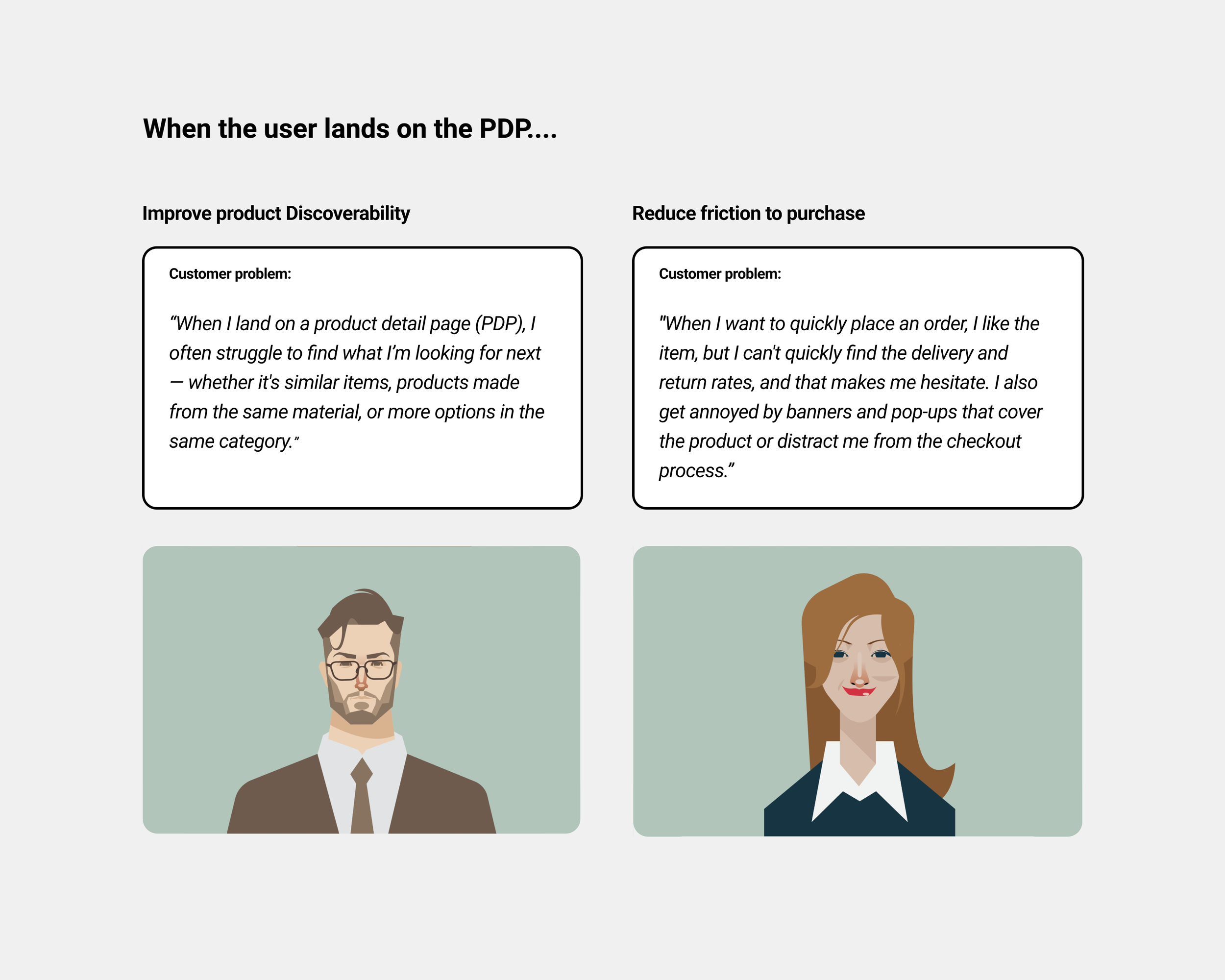
When viewing a specific product, users struggle to quickly access key information, while banners and pop-ups distract from the path to checkout, causing hesitation.
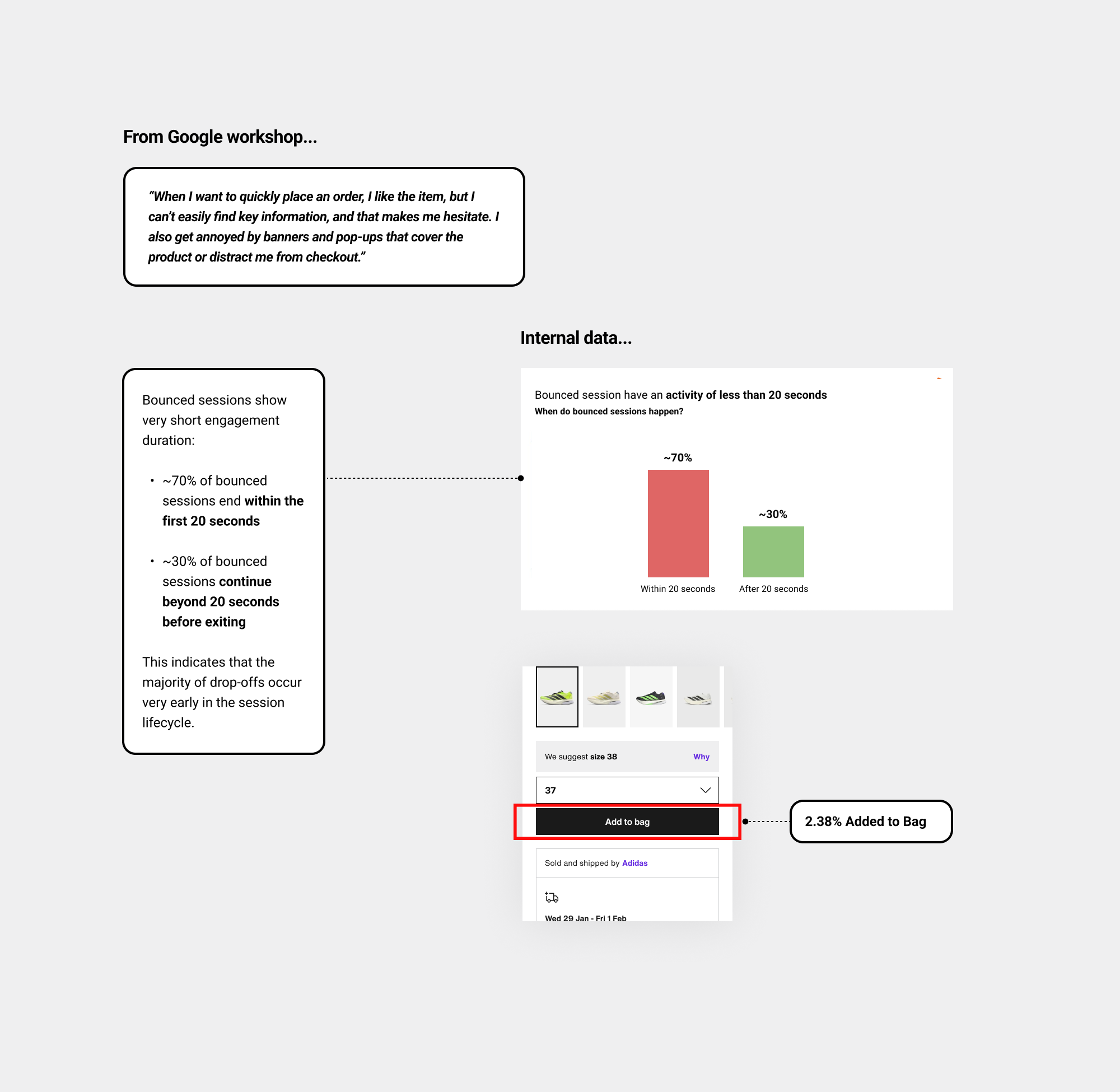
• Data/Insights
Early research signals and insights from the initial Google workshop pointed to this behaviour...
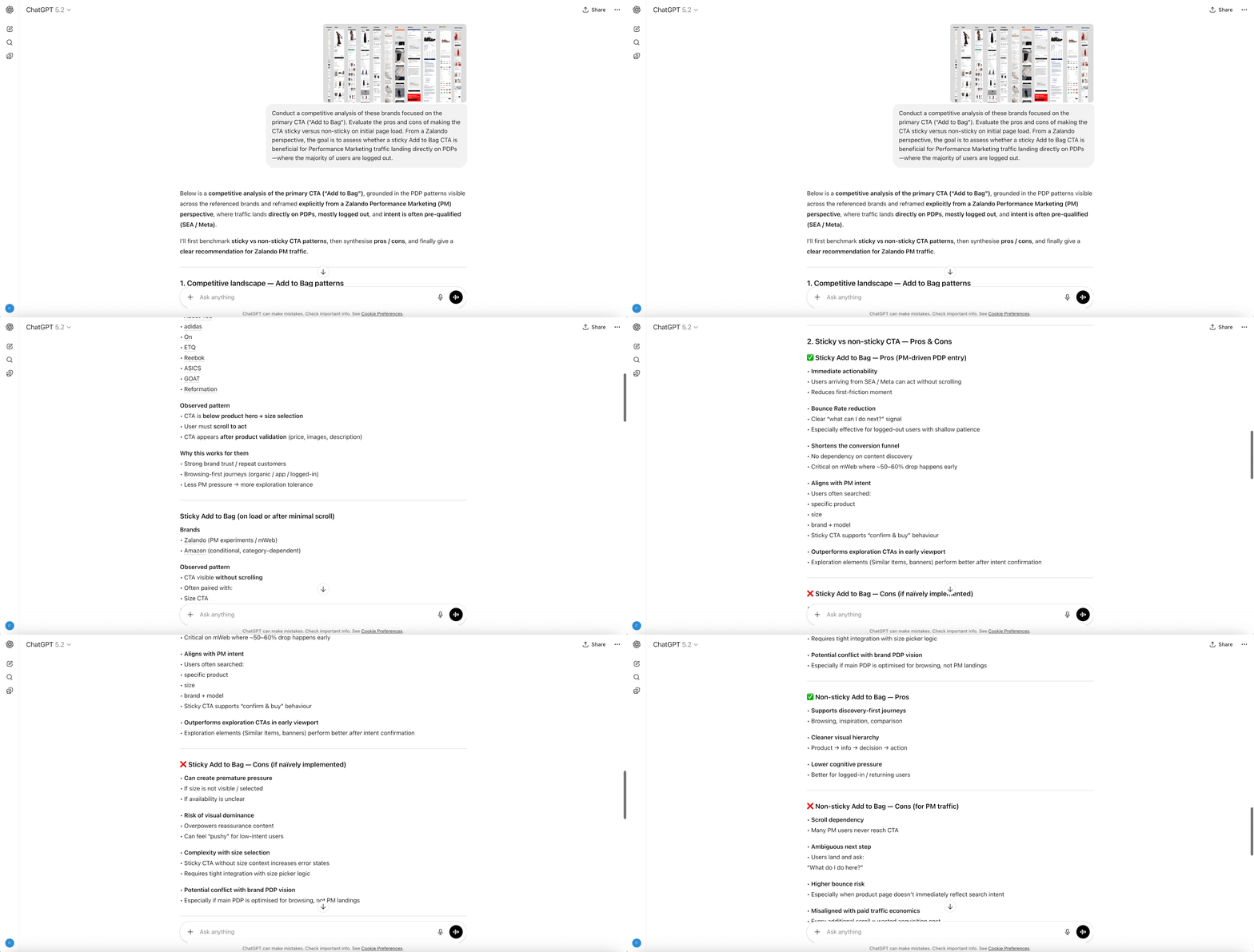
• Competitive analysis
I used ✦ ChatGPT to analyse the pros and cons of introducing a sticky CTA, assessing its suitability for our specific use case, user intent, and the Performance Marketing channel.
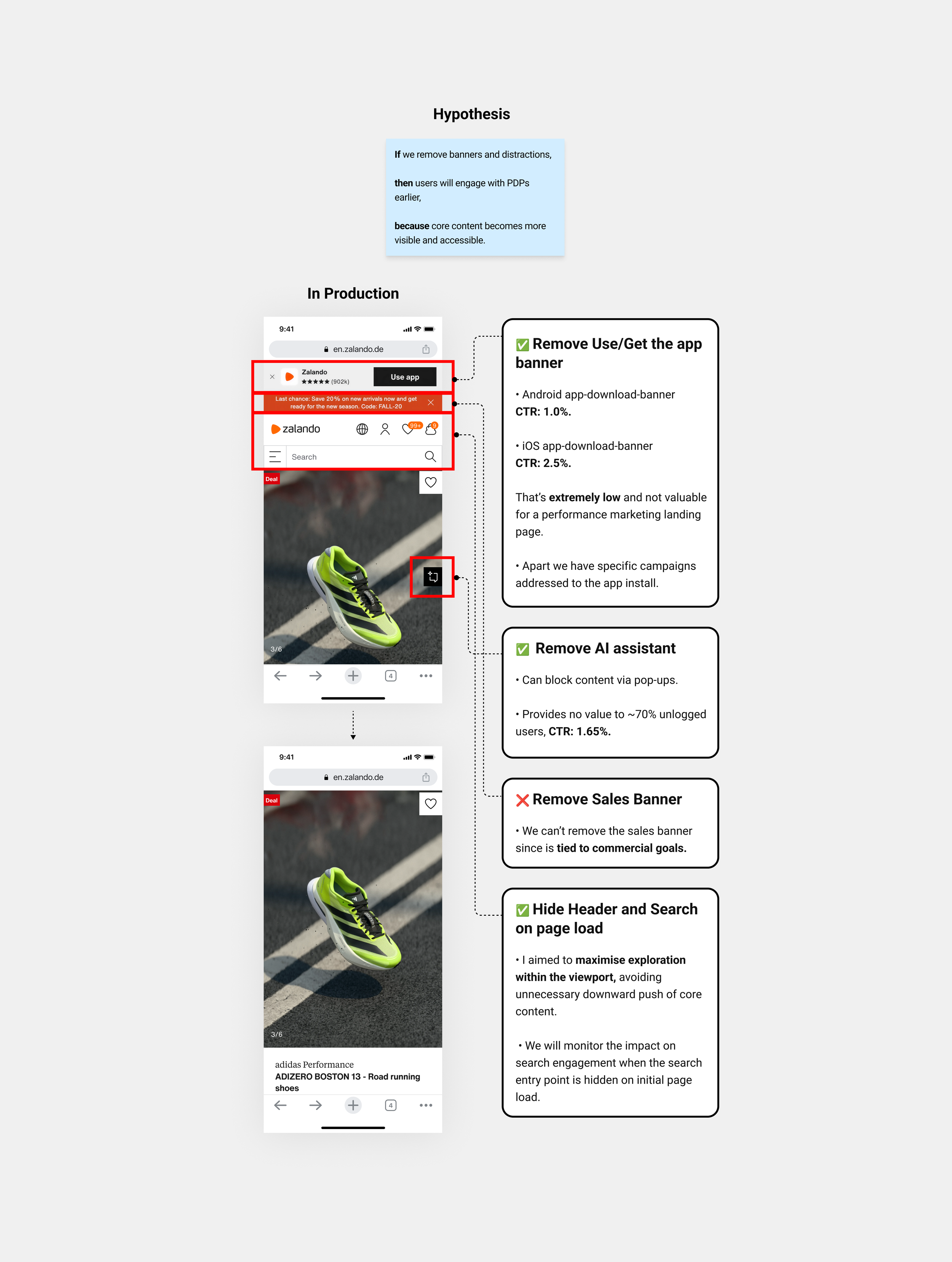
• Let’s analyse banners and other distractions, and assess whether they can be removed.
The initial hypothesis was that removing non-essential elements would improve discoverability and focus user attention.
• Iteration
Highlighting the most representative iteration to speed up progression through the conversion funnel
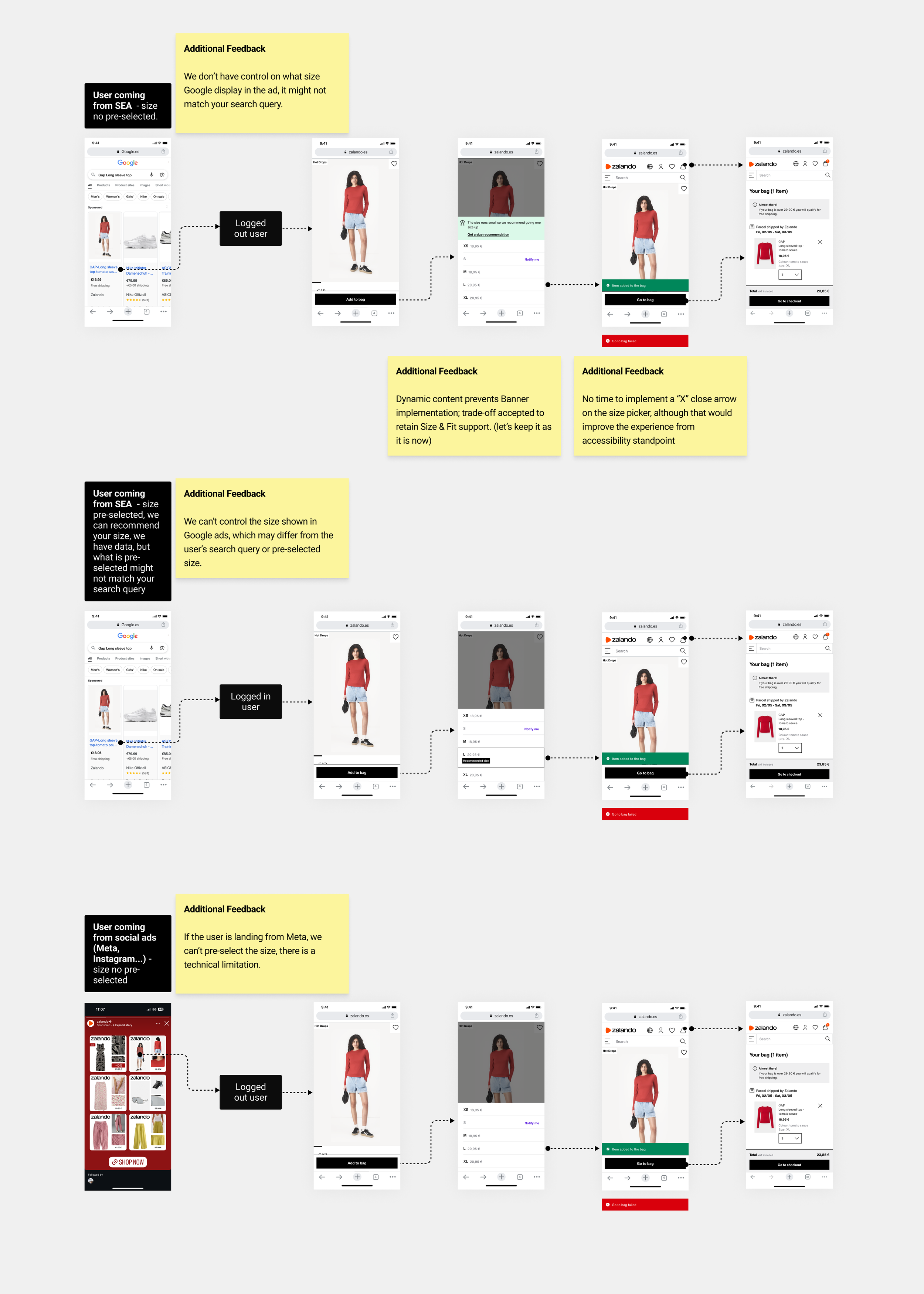
We aligned on exploring how “the sticky add to bag ” could be leveraged to create greater impact. So I created a quick prototype in Figma to gather early feedback applying removed banners and AI assistant and hide search on page load...
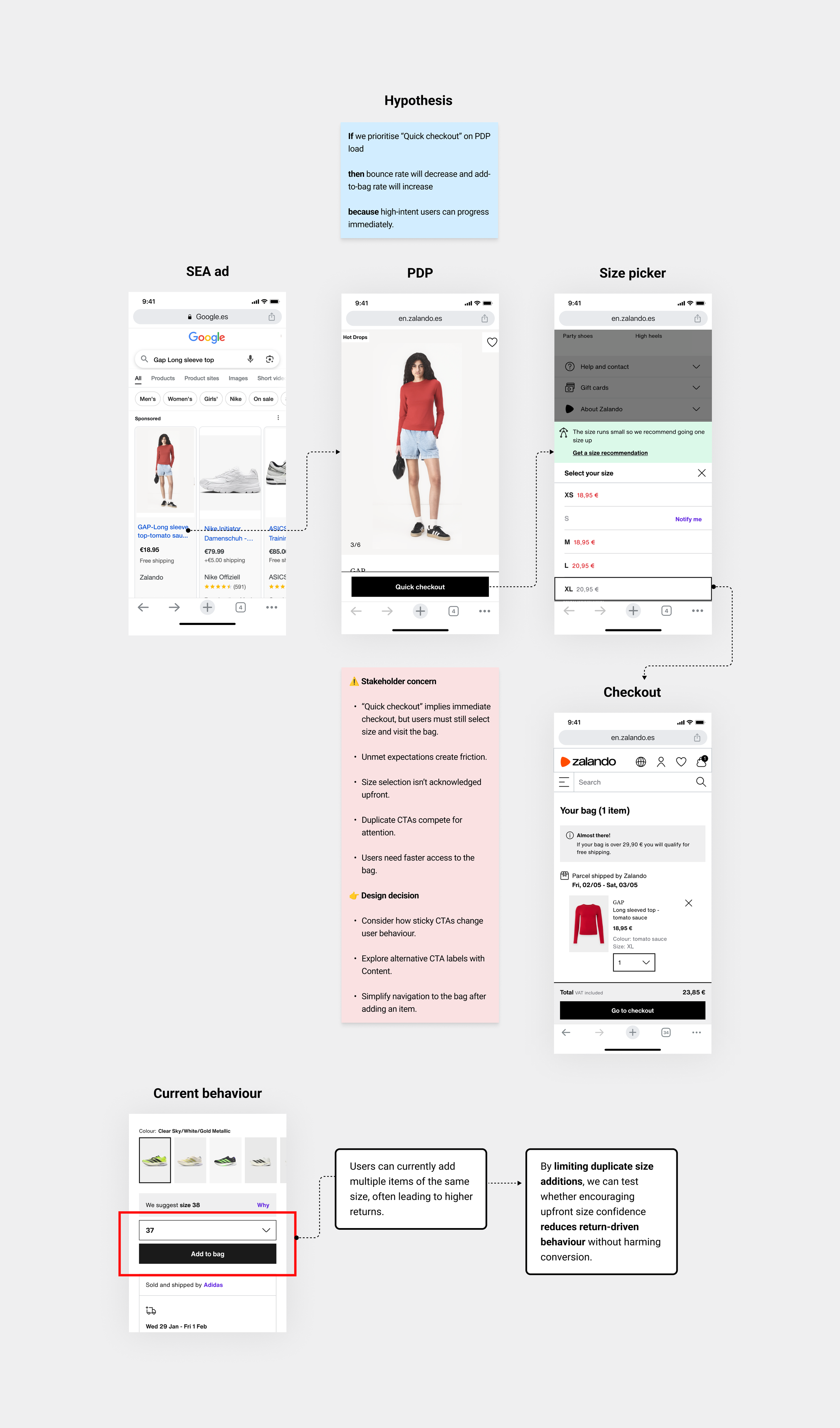
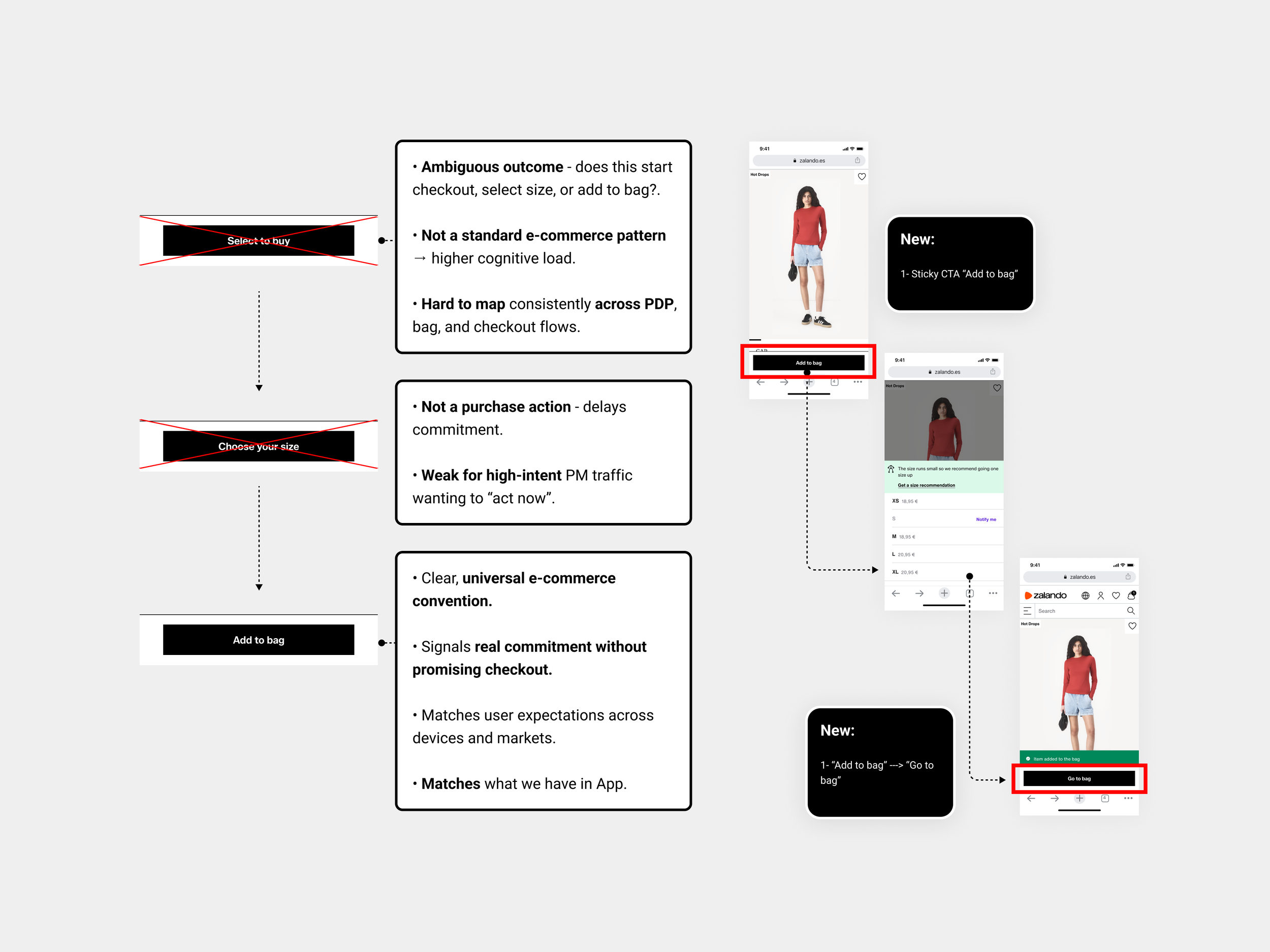
Despite resistance from most departments, since we were changing the user behaviour, the change was justified for the LPO team to evaluate how fast users could be moved through the conversion funnel. So Based on feedback, I aligned with the content team to refine the copy, and redo the flow with “Add to bag”——> “Go to bag”
• Prototype
To create the Bundle 1 prototype, I worked directly in Figma using existing design system components, which was faster and more accurate than Figma Make, as it does not yet fully preserve ZDS components, tokens, and spacing. A high-fidelity prototype was required for EDD inclusion and design sign-off.
A key part of each bundle was aligning with the LPO engineering lead and Reference Store engineers to review scenarios, flows, and edge cases (logged-out vs. logged-in), assess technical constraints, identify blockers, and ensure alignment between production and design-system components.
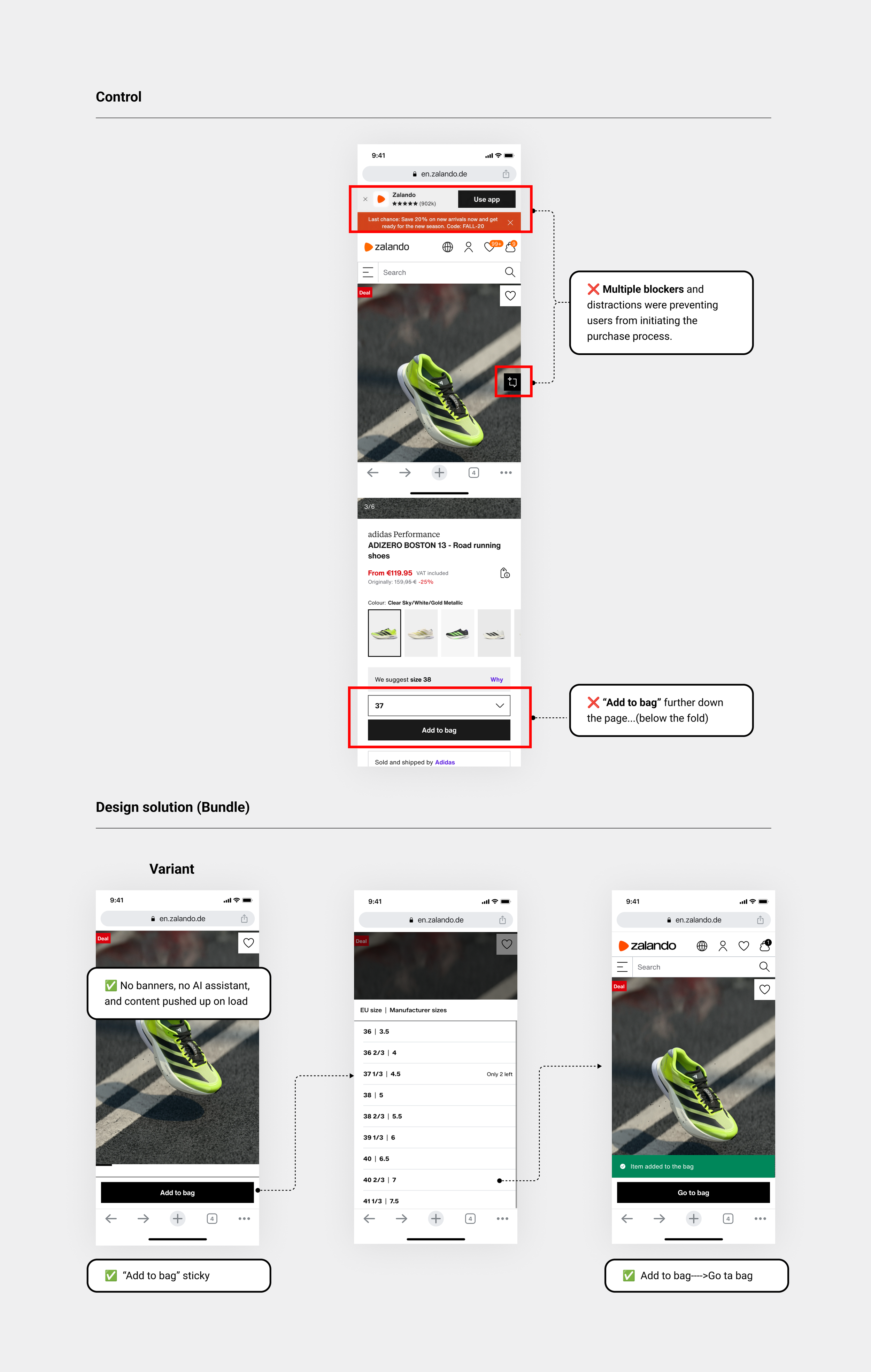
• Design solution
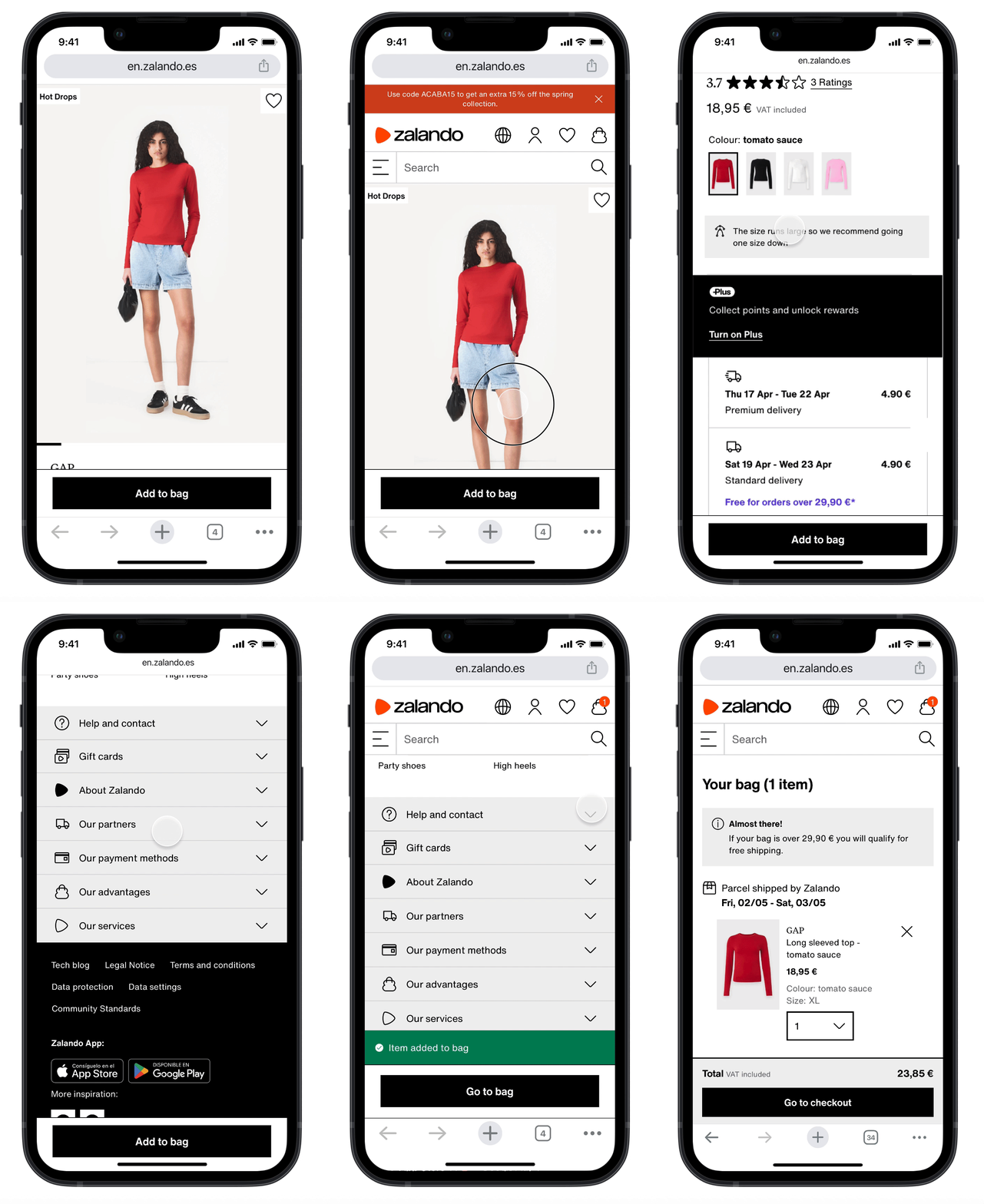
So I ended up with this design solution...
• Trade-off
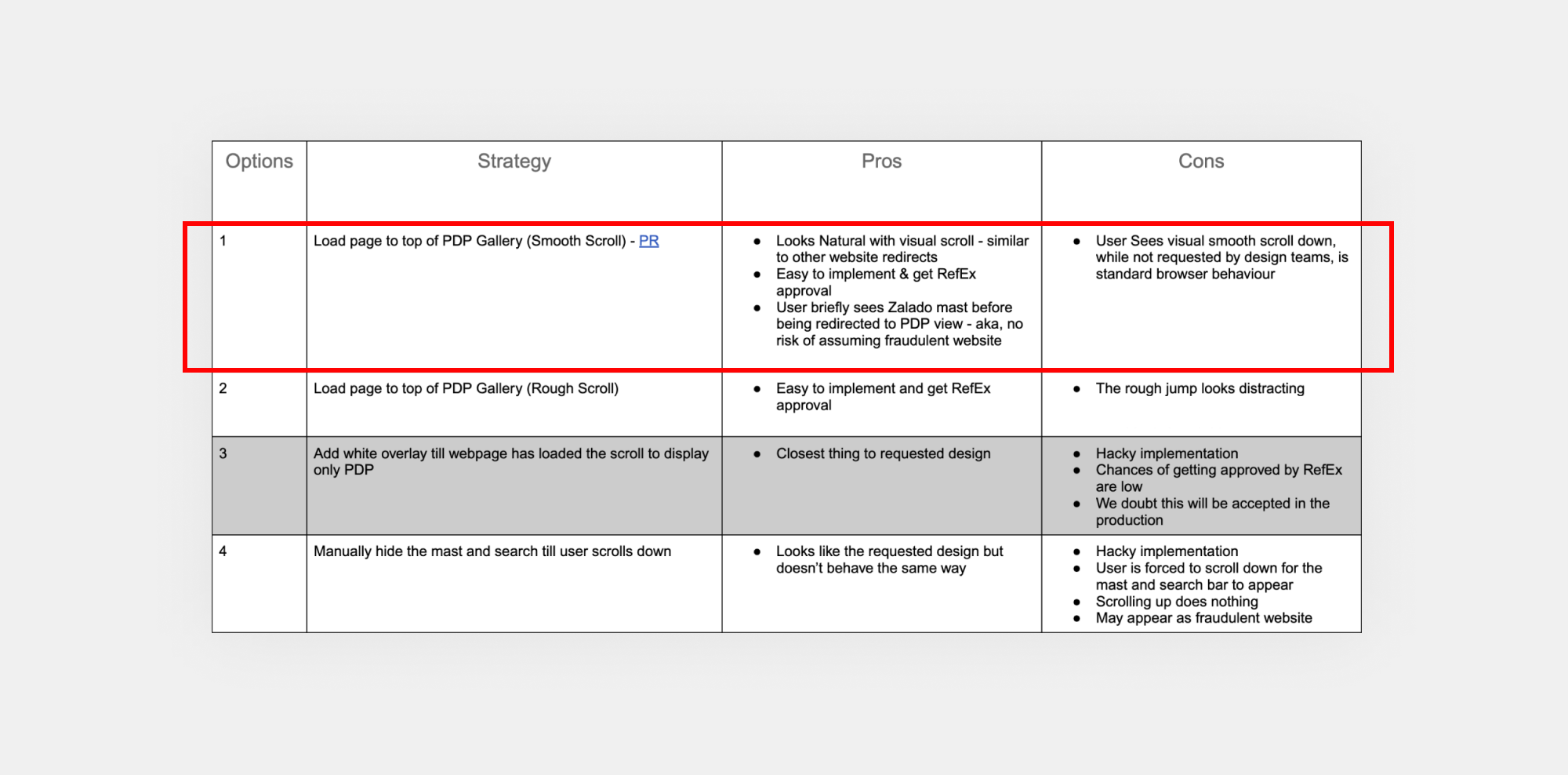
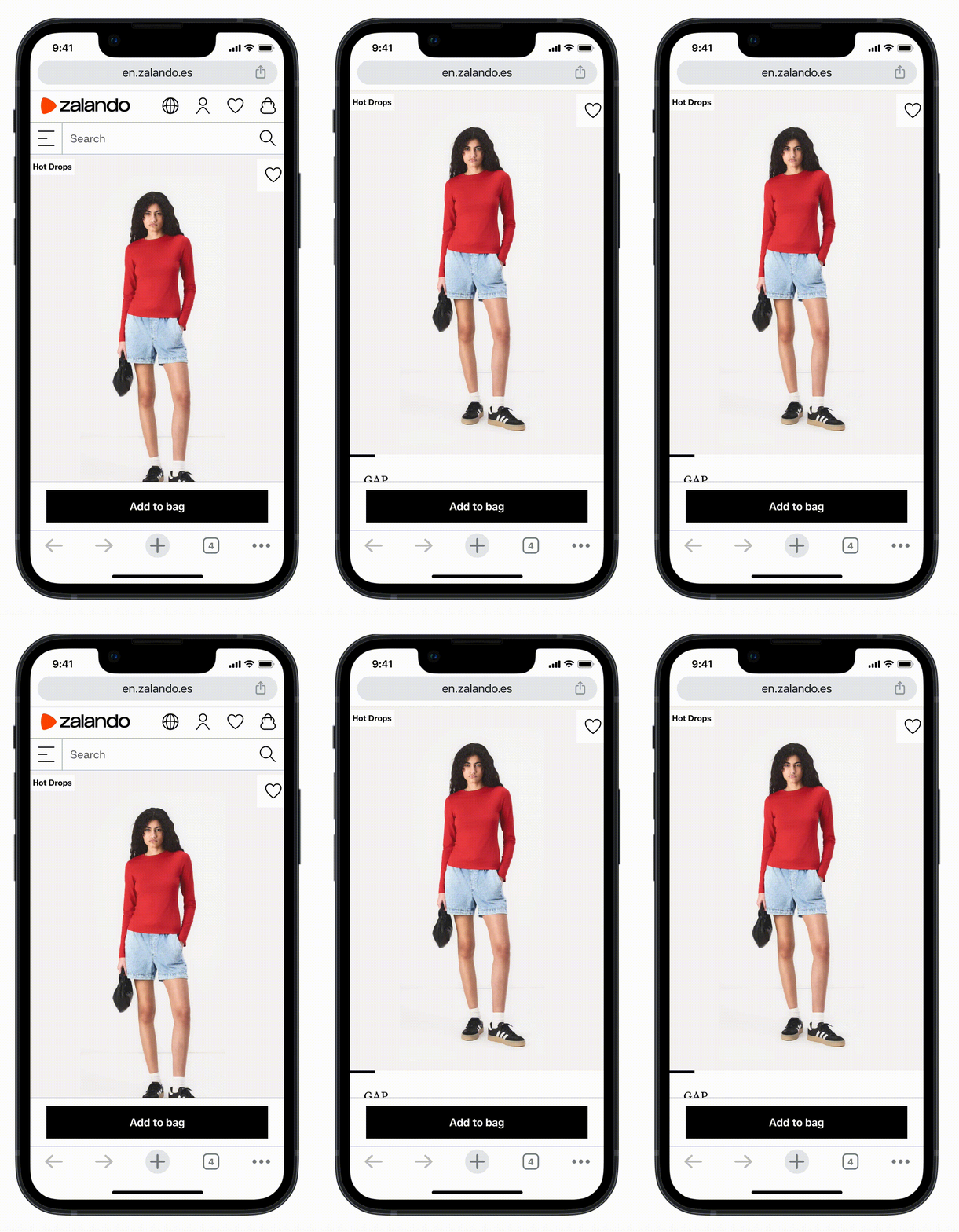
From an implementation standpoint, I worked closely with engineers to iterate on the auto-scrolling behaviour when users land on the PDP. We explored several technical approaches with a focus on keeping the solution lightweight and maintainable within the Reference Store. To compare options, we created a table outlining the trade-offs, and ultimately leaned toward Solution 1.
• Experiment / Hypothesis-led
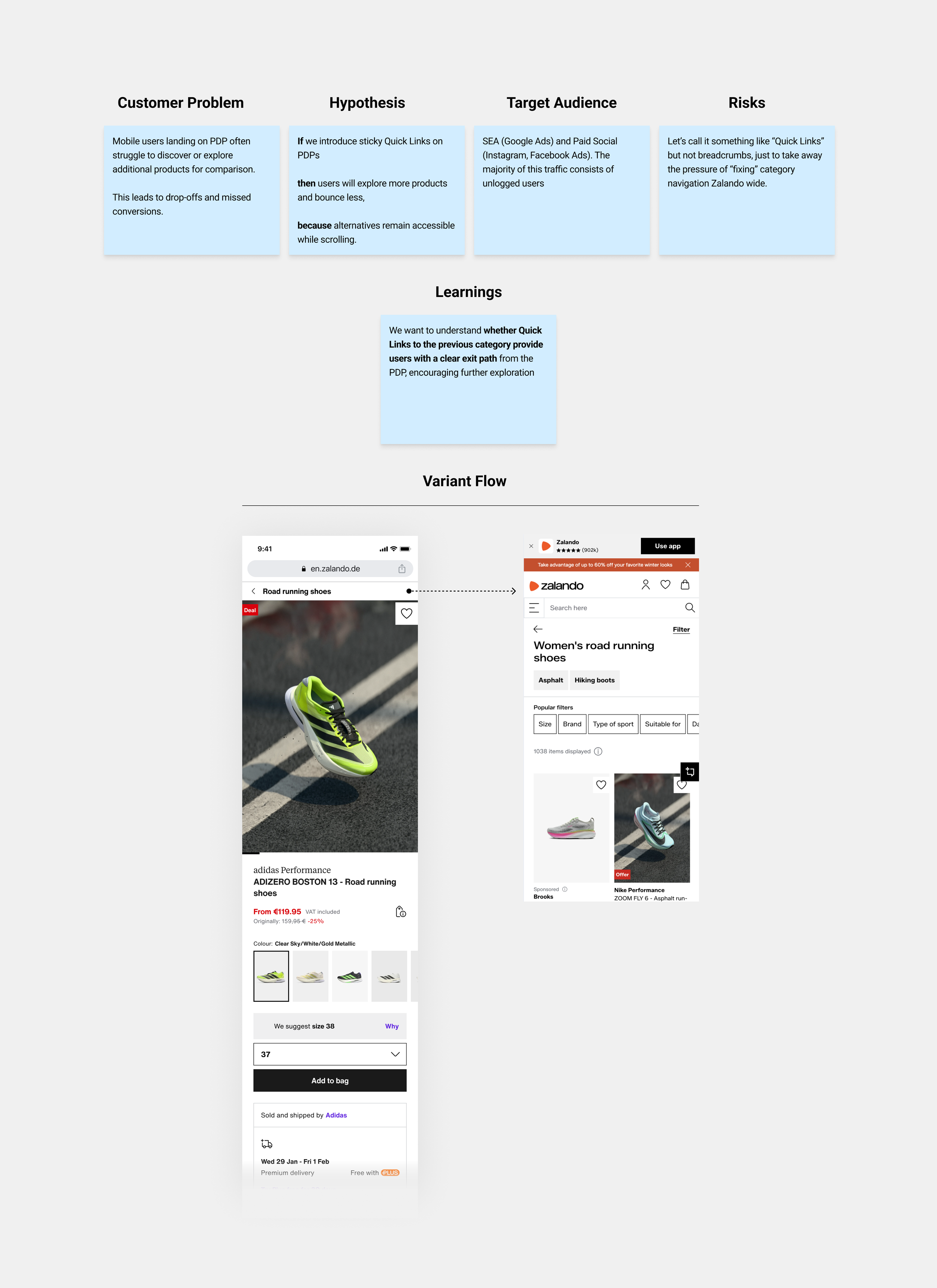
I structured each bundle around 5 key elements: the customer problem, the underlying rationale or hypothesis, the target audience, the associated risks and learnings we want to understand.
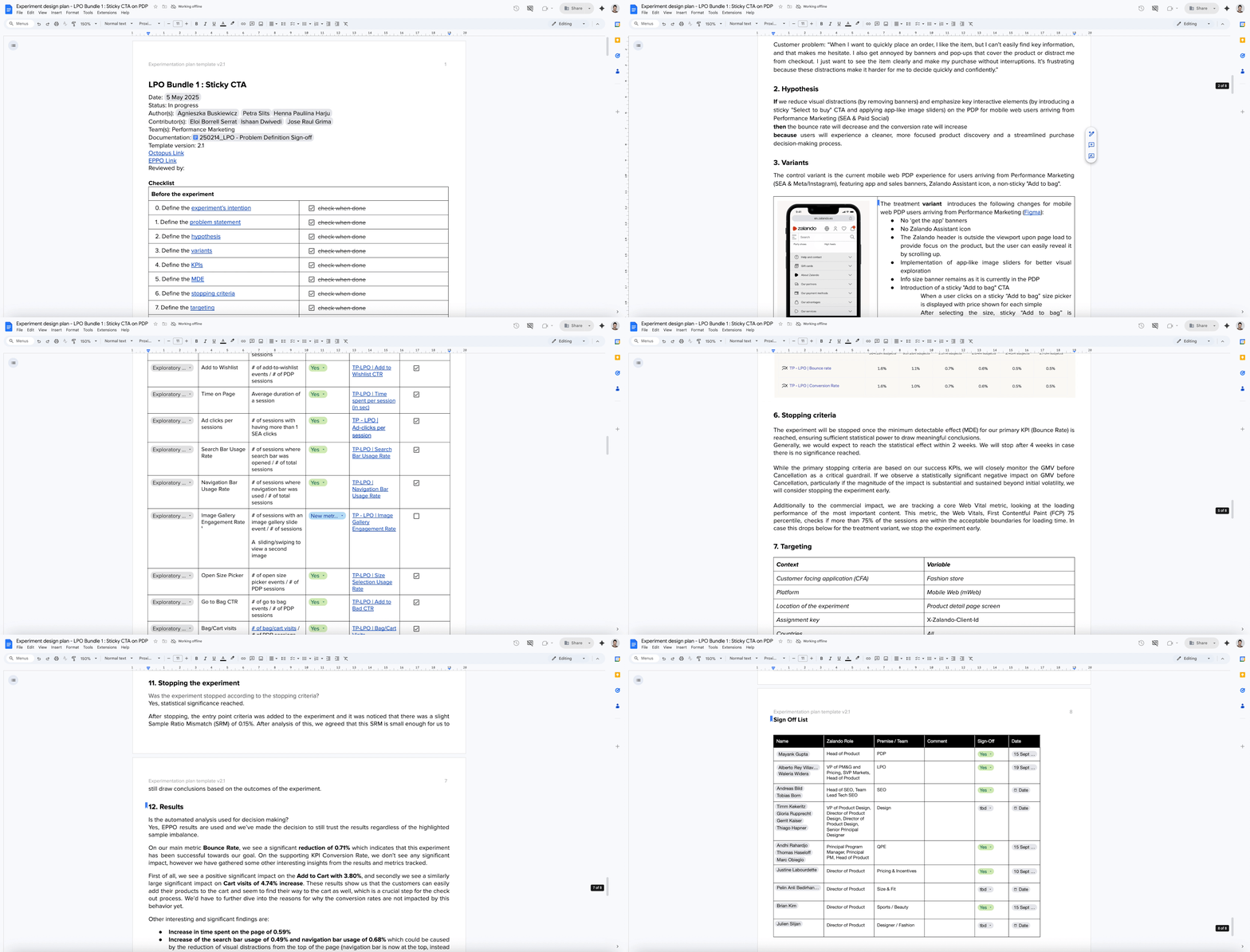
• EDD (Experiment design document) Rollout decision and & KPIs
This document defines the experimentation framework for the Sticky “Add to Bag” CTA on mobile PDPs for Performance Marketing traffic. I worked closely with the PM and analyst on problem statement, hypothesis, KPI definition, guardrails, and decision criteria.
➡ I challenged the measurement strategy (new flow intentionally limited multi-size selection), by introducing GMV before cancellations and return rate alongside GMV after returns, ensuring that conversion gains were evaluated against order quality and long-term GMV impact.
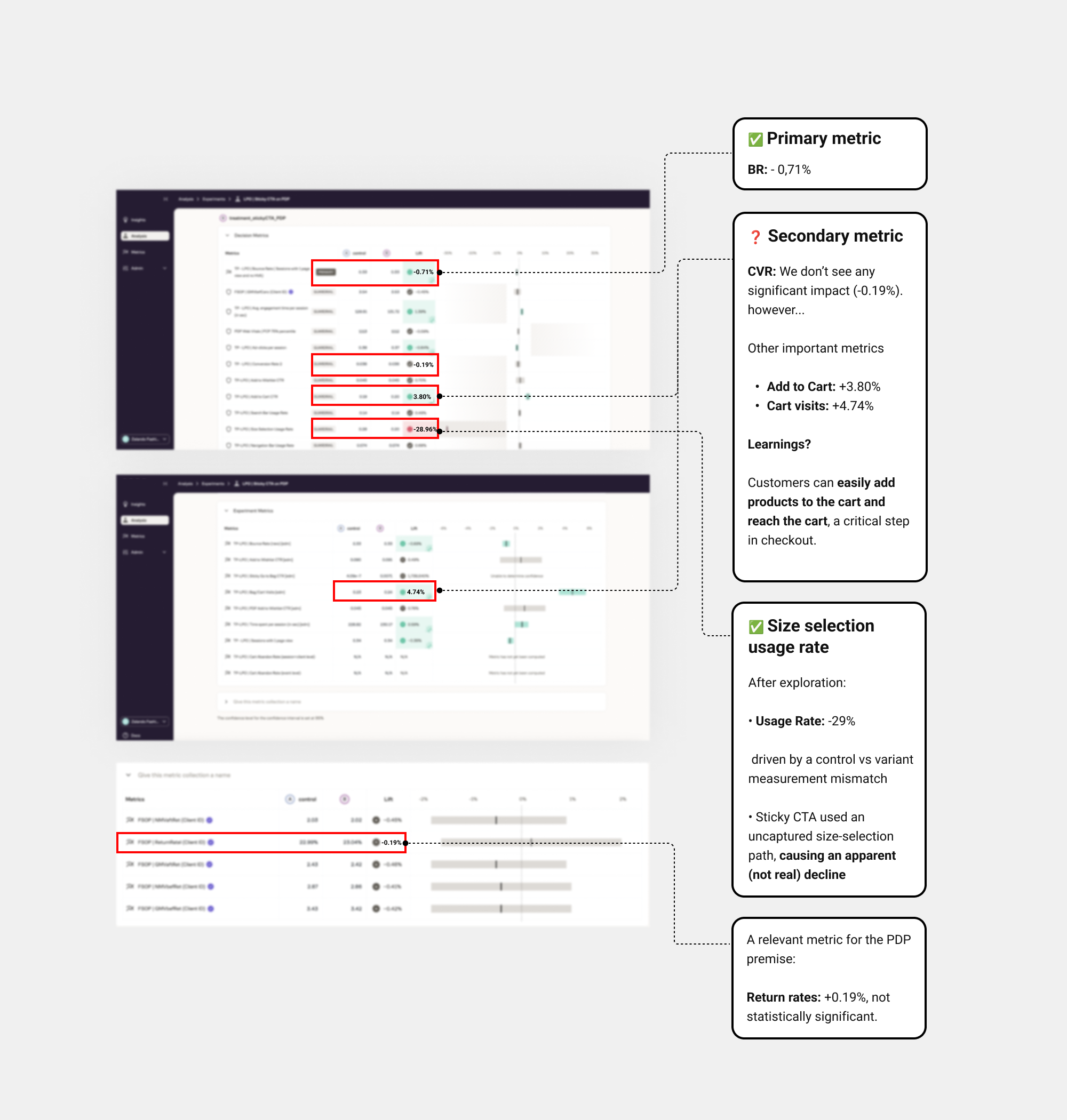
• EPPO Results and Key insights
Analysis results experiment Bundle 1
• 🚀 Learnings and Rollout decision
A sticky Add-to-Bag CTA that opens the size picker helps users move faster into the purchase flow by making the primary action constantly accessible. Engagement improved and return rates showed no significant impact, validating rollout with GMV quality guardrails.
• BR: -0.71%
• CVR: CVR is treated as neutral / inconclusive.
Rollout decision: The hypothesis was validated and we rolled out this feature to PM channel.
☝ In the end, Bundle 1 was released after Bundle 2 and positioned accordingly in the roadmap, as it required more time to implement than initially expected.

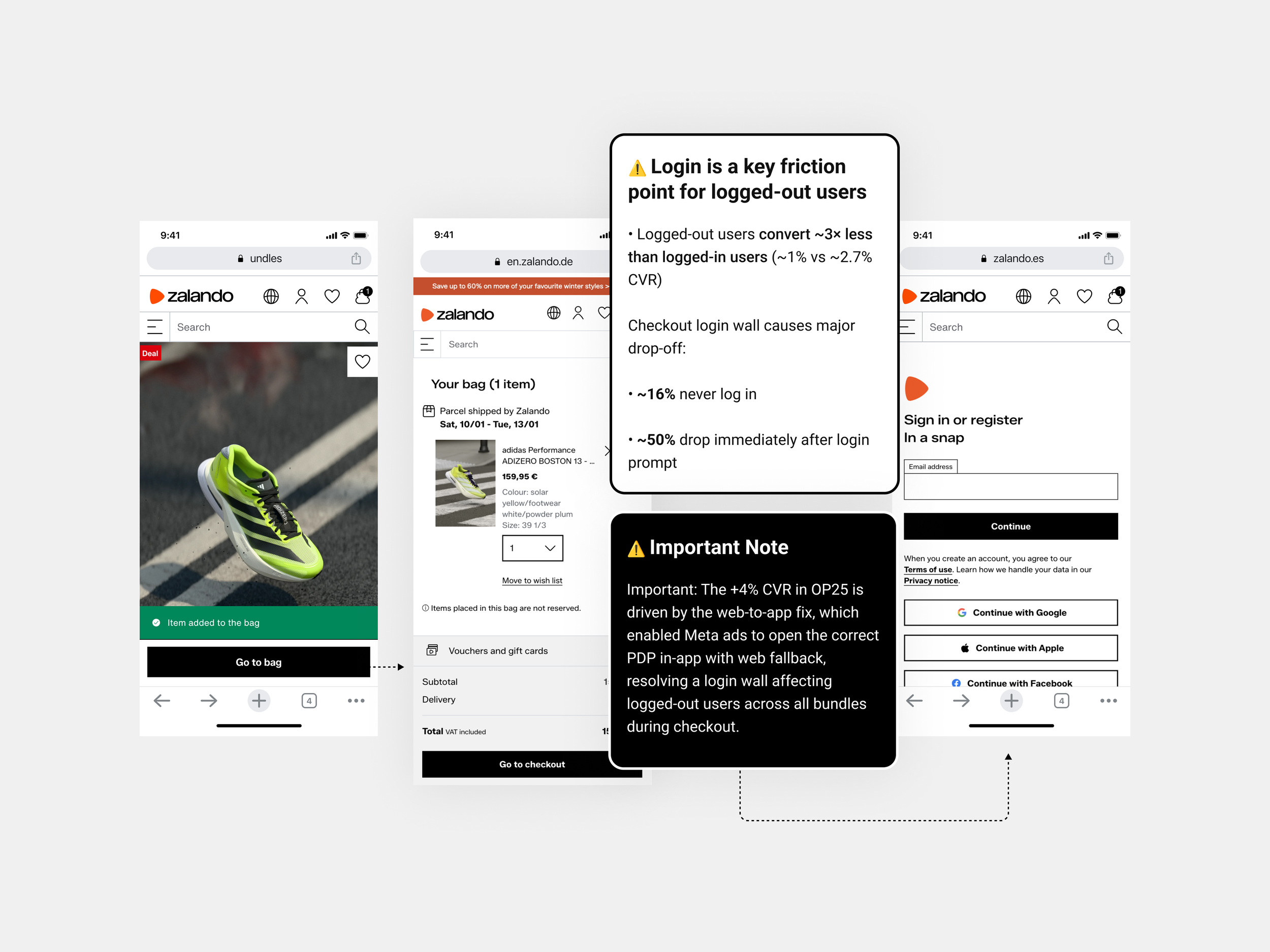
• 🚩 Why the Conversion Rate remained neutral?
This forced login gating interrupts purchase intent for logged-out and directly suppresses mobile web CVR by blocking high-intent users at critical moments. In 2026, we plan to address this by exploring alternative solutions, such as guest checkout. This change will affect all bundles and is expected to deliver a significant uplift in CVR.
• Foundational personalisation architecture
After Bundle 1, we began talks on 2026 model capabilities, shifting Performance Marketing toward dynamic, intent-aware, session-adaptive system
To ensure the PDP could scale beyond short-term optimisation in 2026, I mapped the capabilities of the underlying personalisation models, distinguishing between session-level intent, history-based signals, and what works reliably for logged-out PM users.
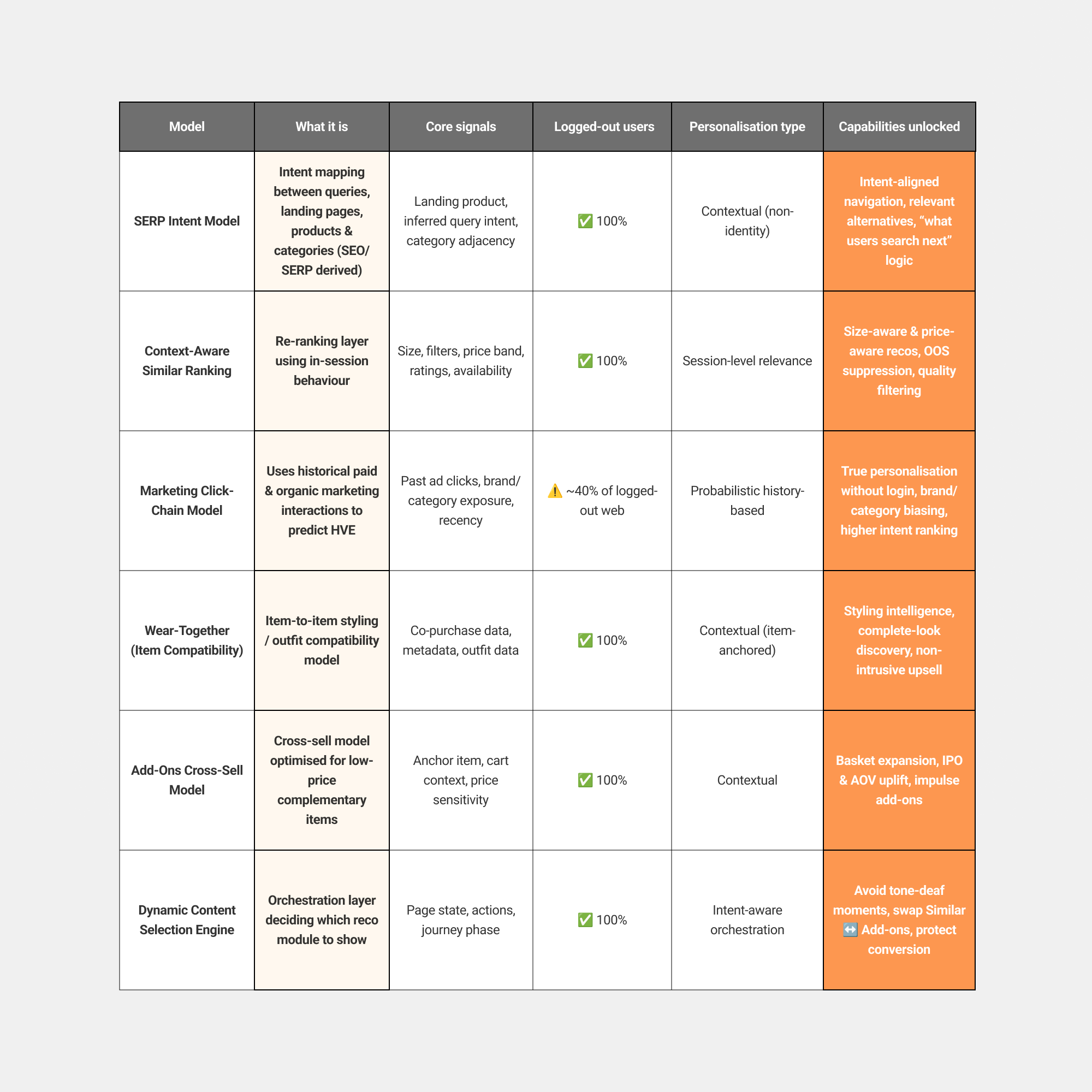
The effects of personalisation will not be fully felt or visible until the end of 2026
Bundle 2 (Quick Links)
• Context
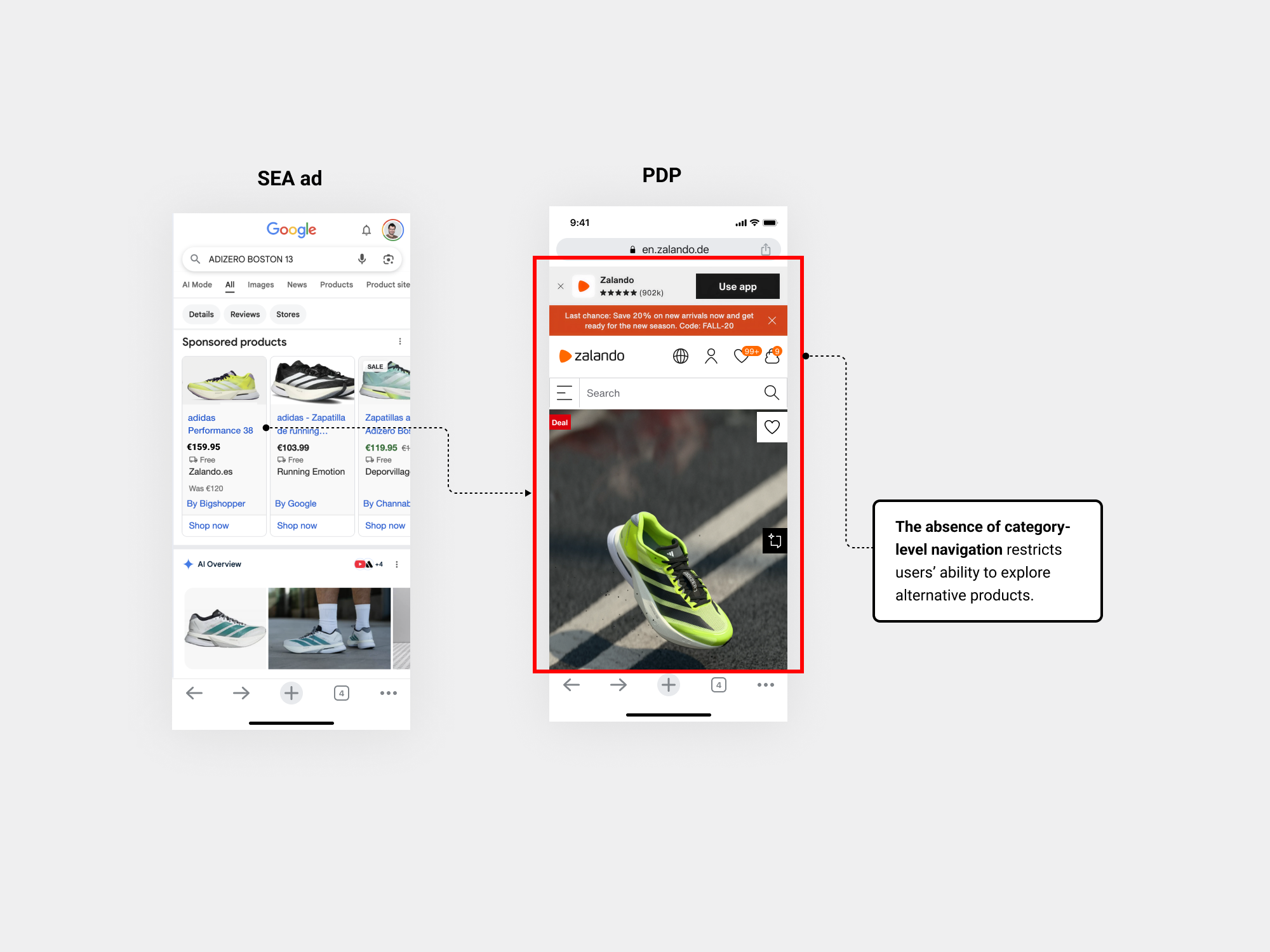
Users who land directly on PDPs struggle to find clear pathways to explore alternative products.
• Data/Insights
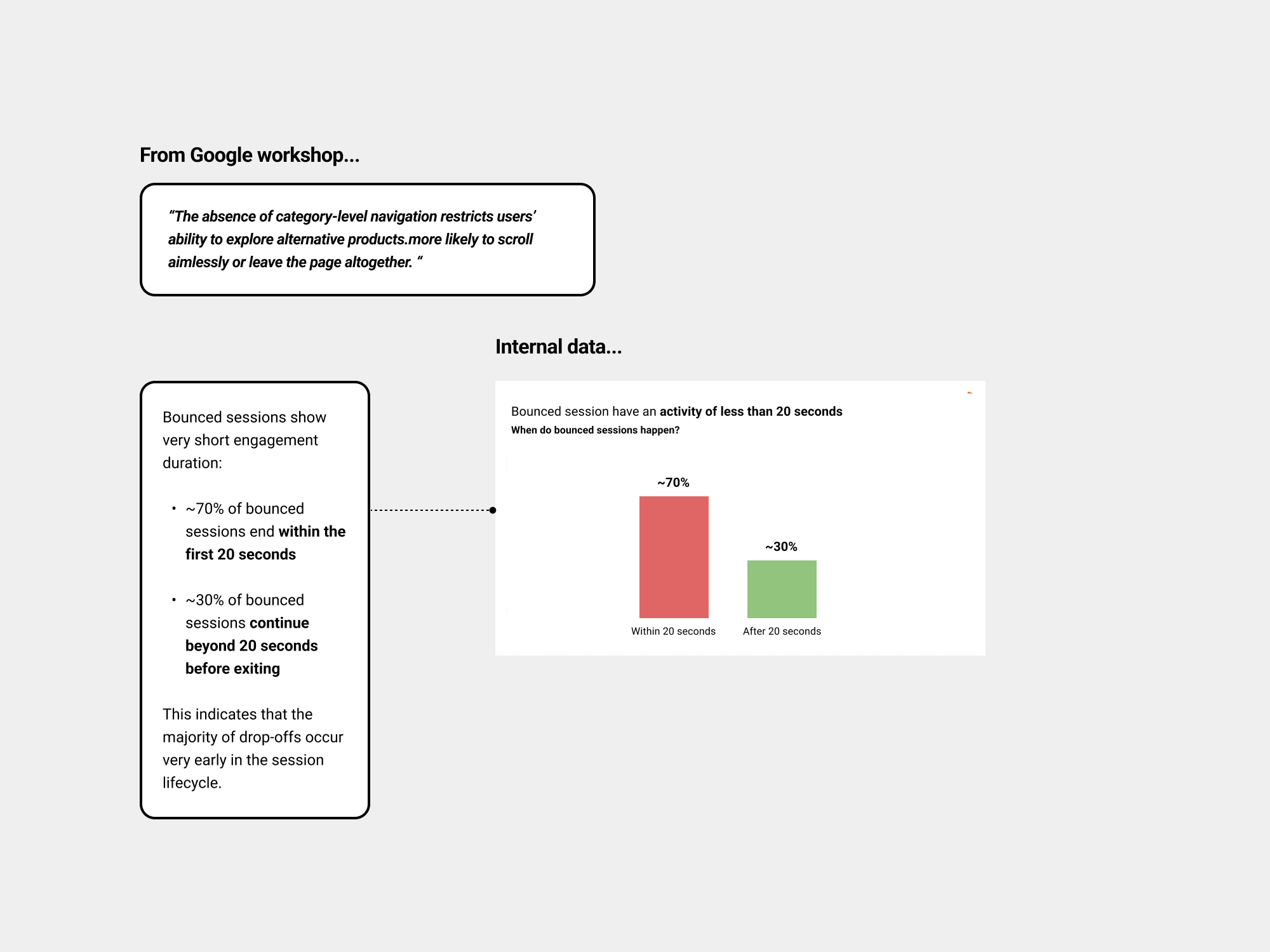
Early research signals and insights from the initial Google workshop pointed to this behaviour...
• Iteration
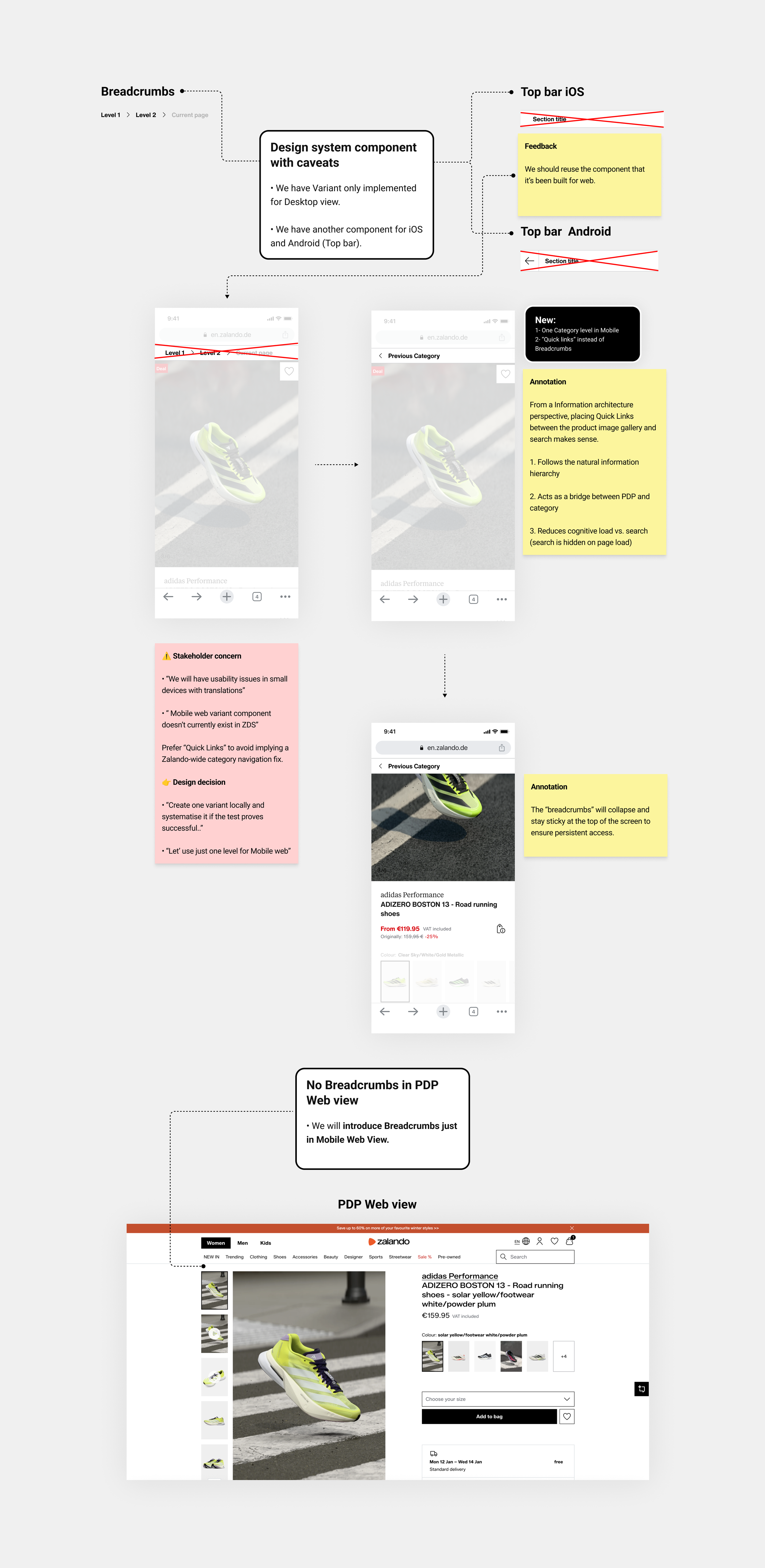
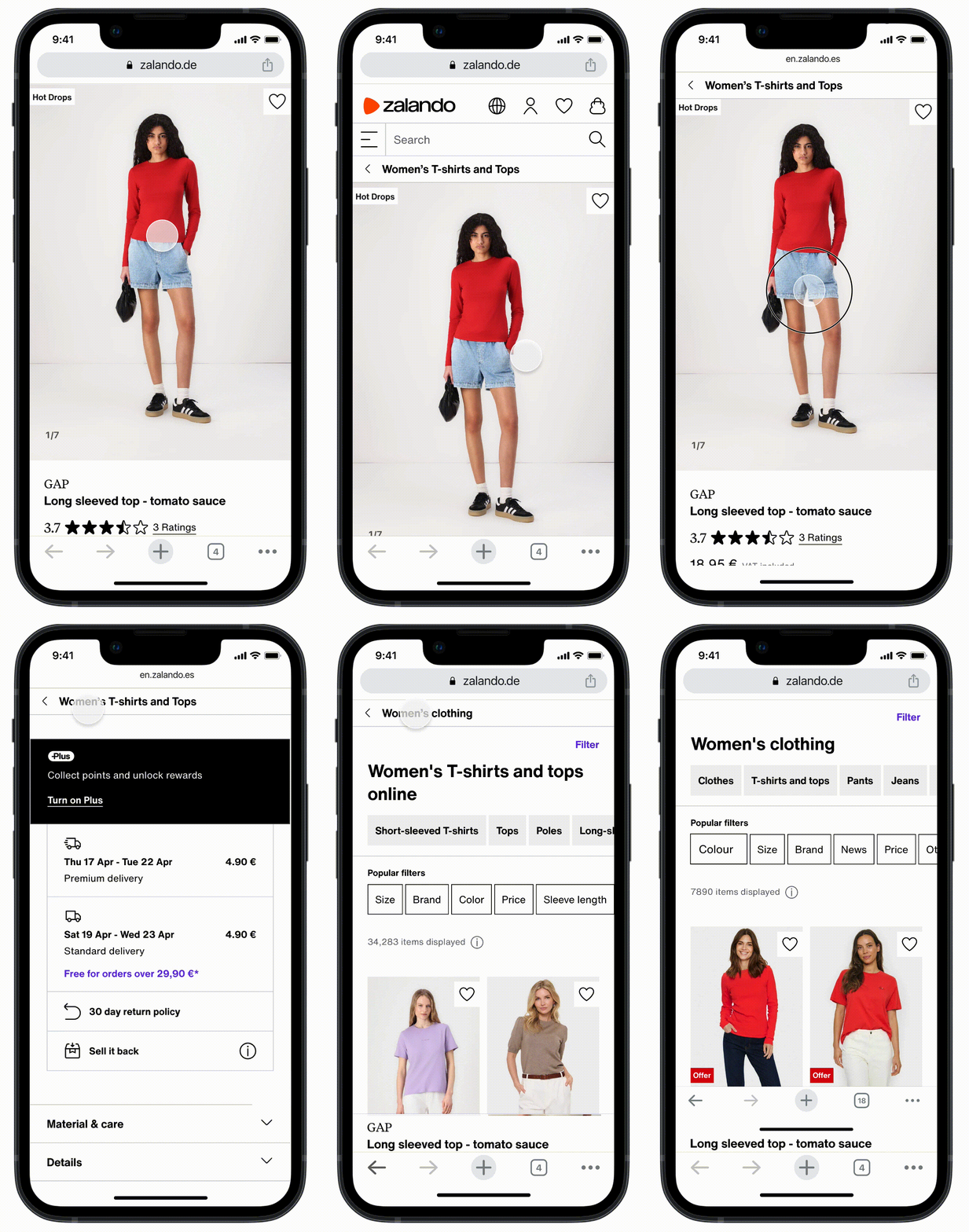
For Bundle 2, the solution was straightforward. Insights from Google interviews had already shown that introducing breadcrumbs would be valuable, especially in addressing several issues users were encountering.
I started by exploring the components available in the design system and reviewing their behaviour in the desktop experience, while gathering feedback from the Ref. Store team and the ZDS (Zalando Design System) team.
• Prototype
Once aligned with ZDS and Ref.Store on limiting this navigation feature to mobile, I developed a prototype and presented it to LPO stakeholders to validate the approach.
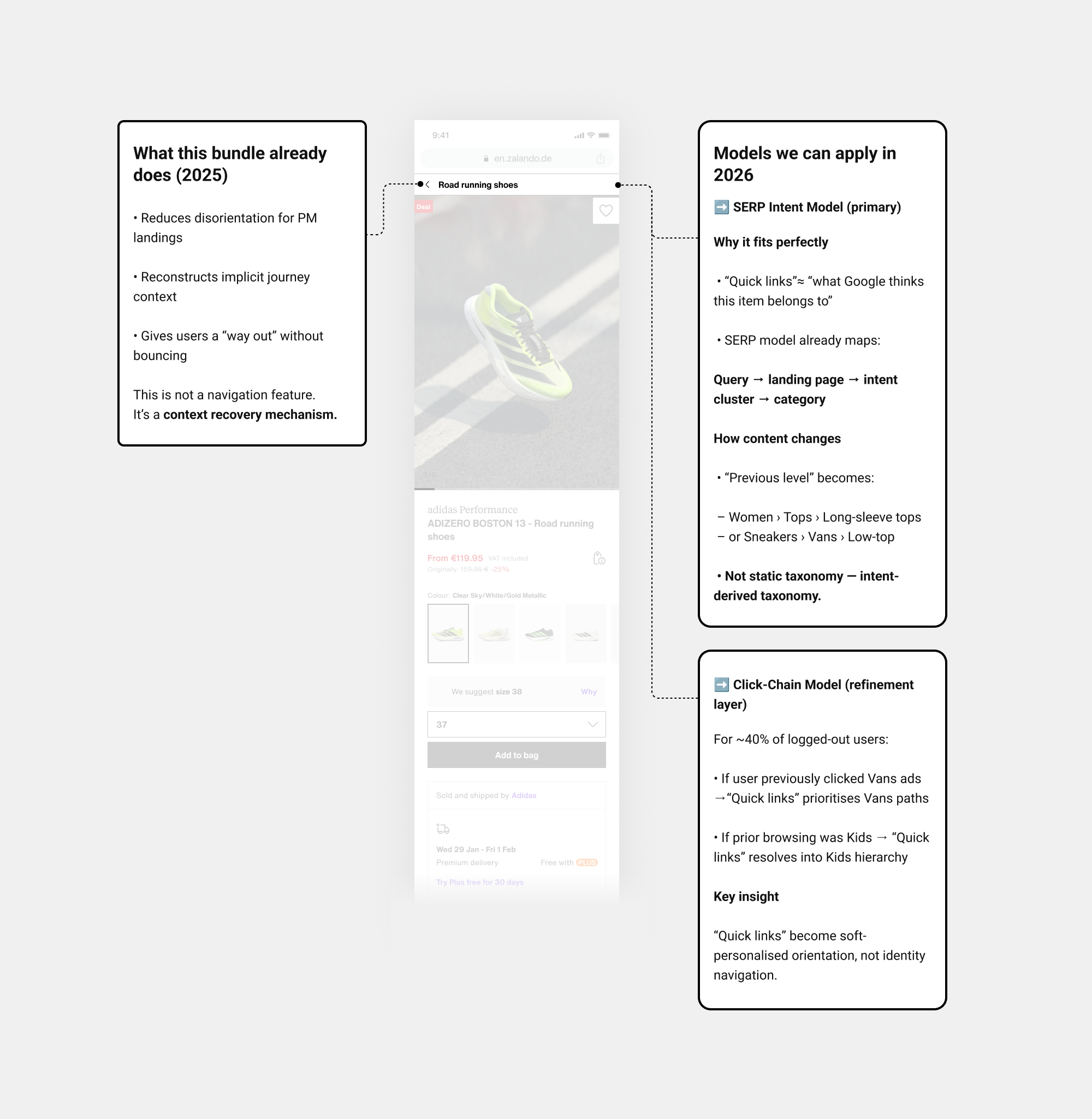
• Personalisation 2026: What models can be leveraged in 2026 for Bundle 2?
“Quick Links” enable personalisation at scale by acting as an intent-aware layer rather than a static navigation element. Driven by SERP intent and behavioural signals, they will adapt category context per user and entry point.
• Experiment / Hypothesis-led
• EPPO Results and Key insights
• 🚀 Learnings and Rollout decision
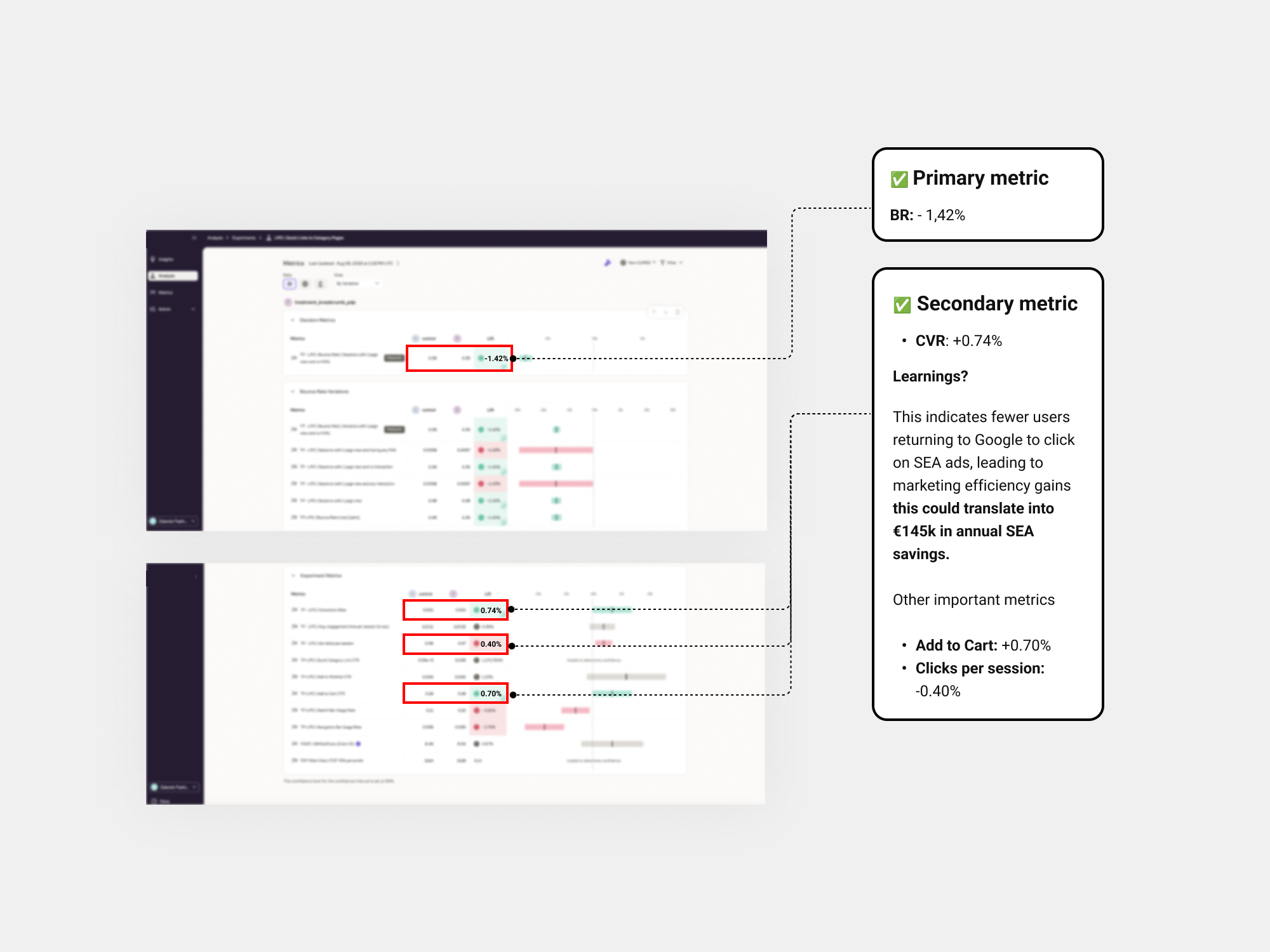
3.6% of sessions used the quick link to category pages, a strong signal that this feature is helpful and positively contributing to navigation.
• BR:-1.42%
• CVR: CVR is treated as neutral / inconclusive
Rollout decision: We had a slightly drop on Search usage -0.61%,
likely to not being visible on page load.
☝ The next iteration will reintroduce both elements and relaunch the test under a new experiment ID to validate whether this drives a greater BR reduction while resolving usability concerns.
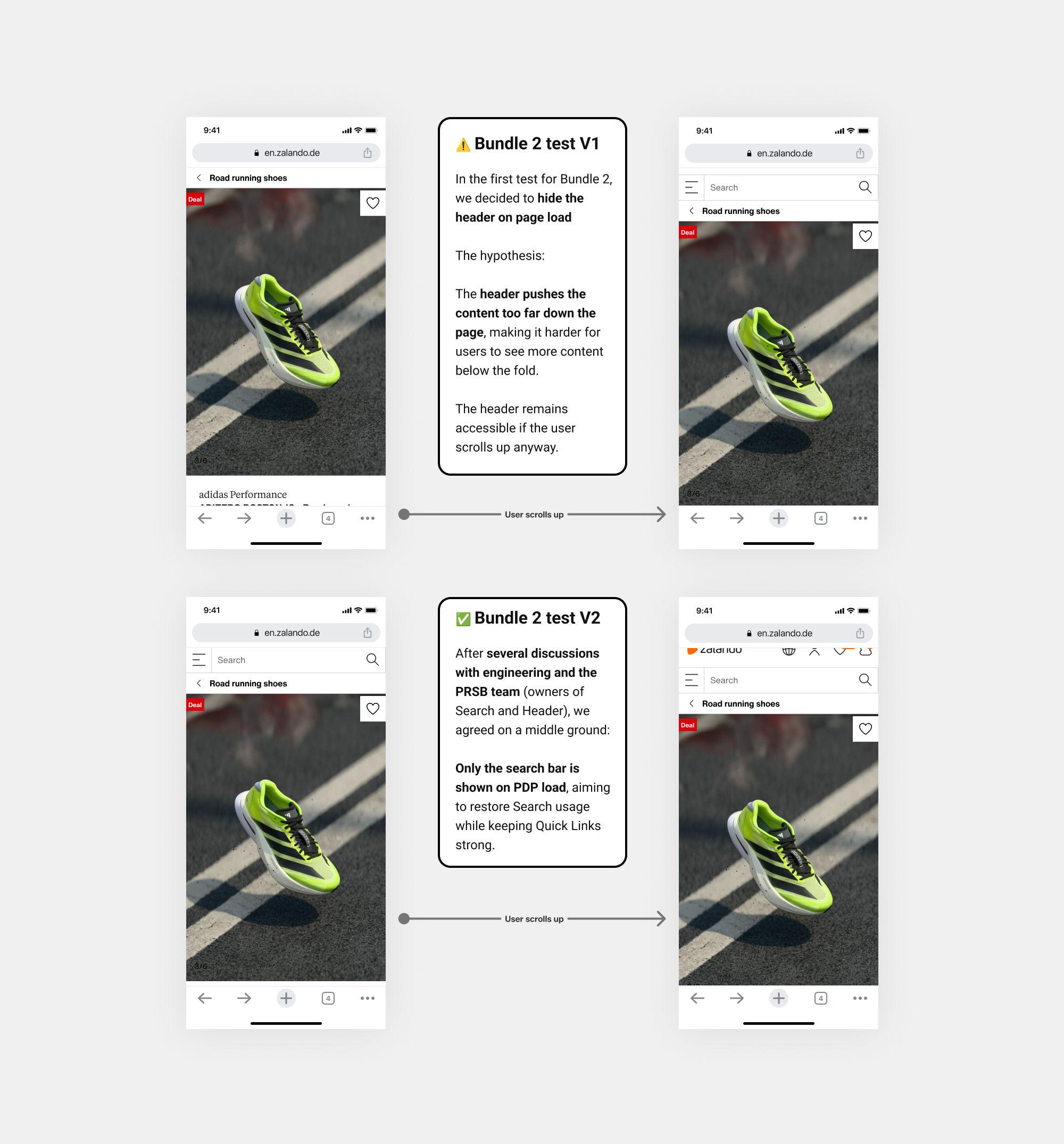
• 🚀 Learnings and Rollout decision
While no other metrics showed significant change, “quick links” were used in 3.9% of sessions—consistent with the original test and the search usage had a significant improvement.
• BR:-1.50%
• CVR: + 0.12%
Rollout decision: The hypothesis was validated and we rolled out V2 this feature to PM channel (Only the search bar is shown on PDP load)
Bundle 3 (Similar items carousel)
• Context
Workshop interviews indicated that when users consider alternatives, they tend to prioritise options with similar core attributes.
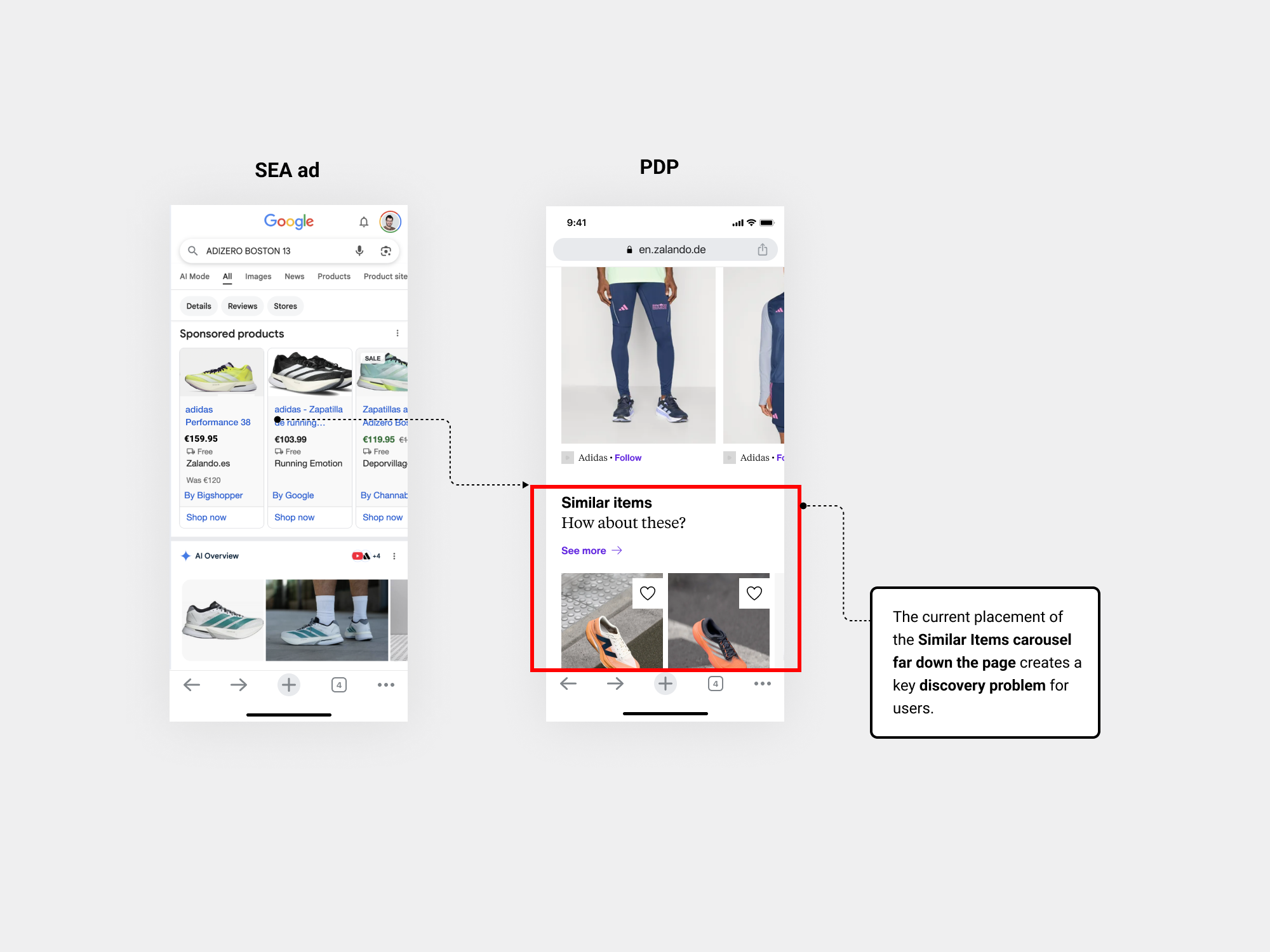
• Data/Insights
Early research signals and insights from the initial Google workshop pointed to this behaviour...
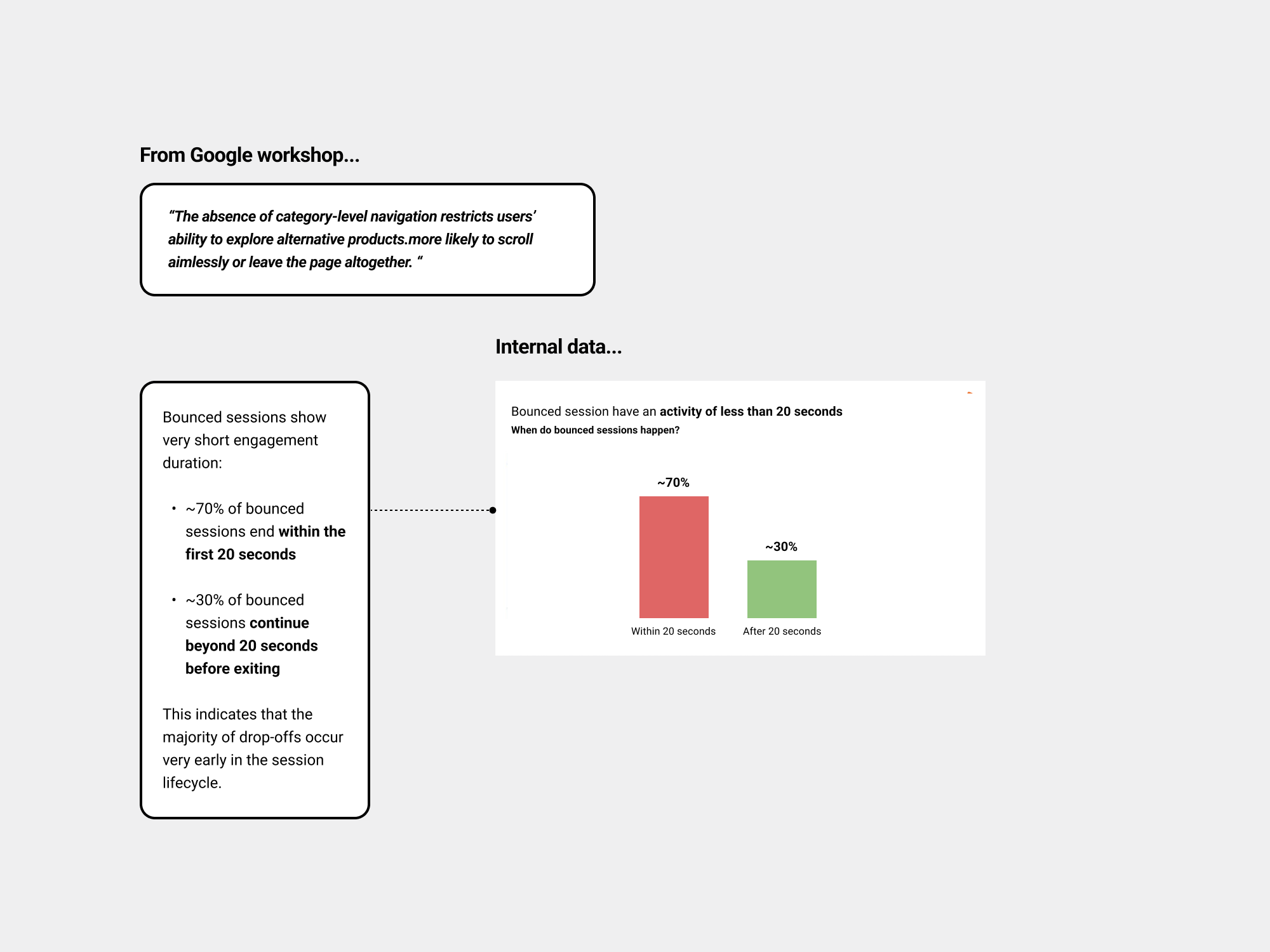
• Iteration
Through idea generation sessions in Figma Make and a Google workshop, we aligned on exploring how “Similar Items” could be leveraged to create greater impact.
I explored several hypotheses, but I’m highlighting the most representative one to focus on the key learnings, so I created two a quick prototypes in Figma to gather early feedback...
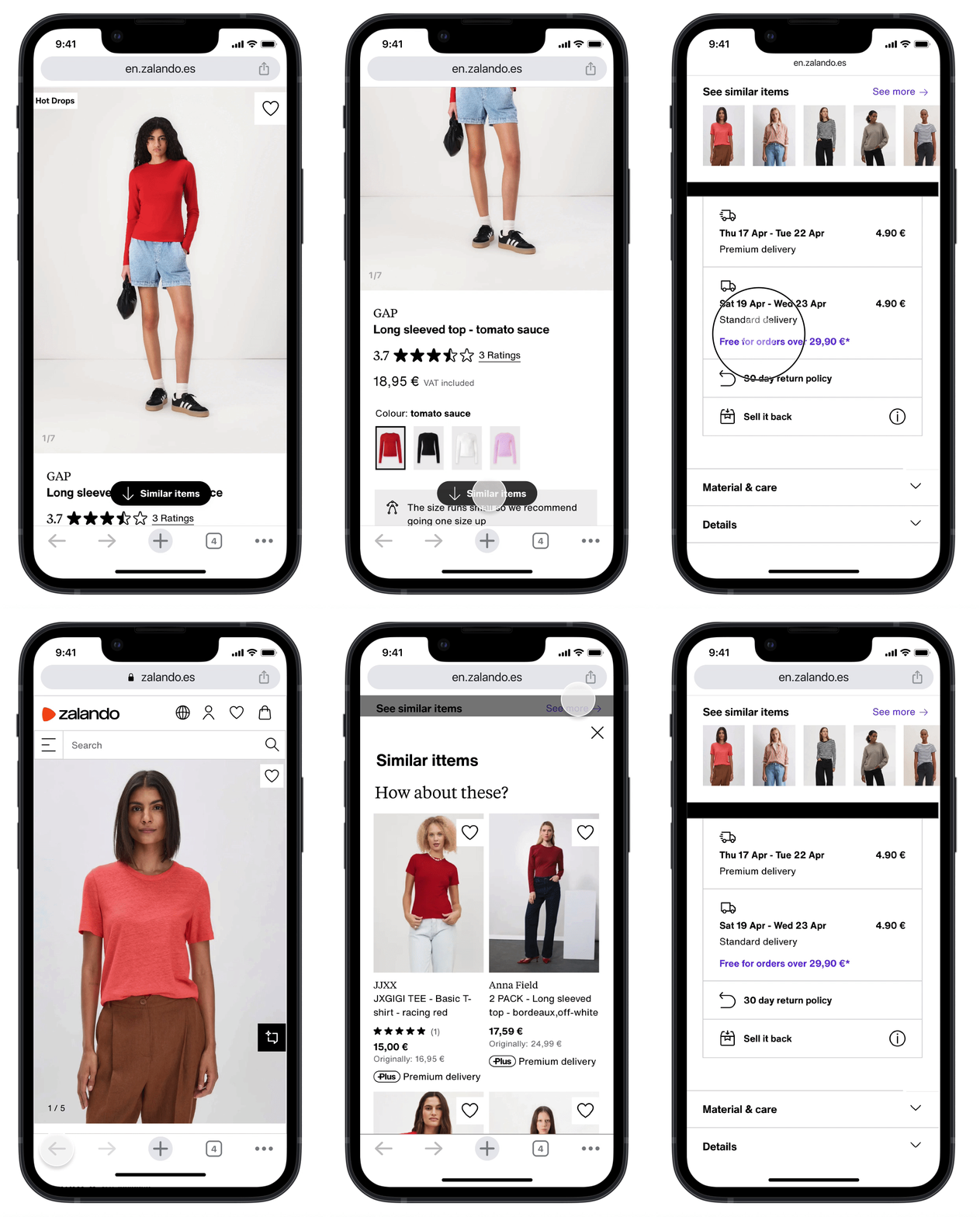
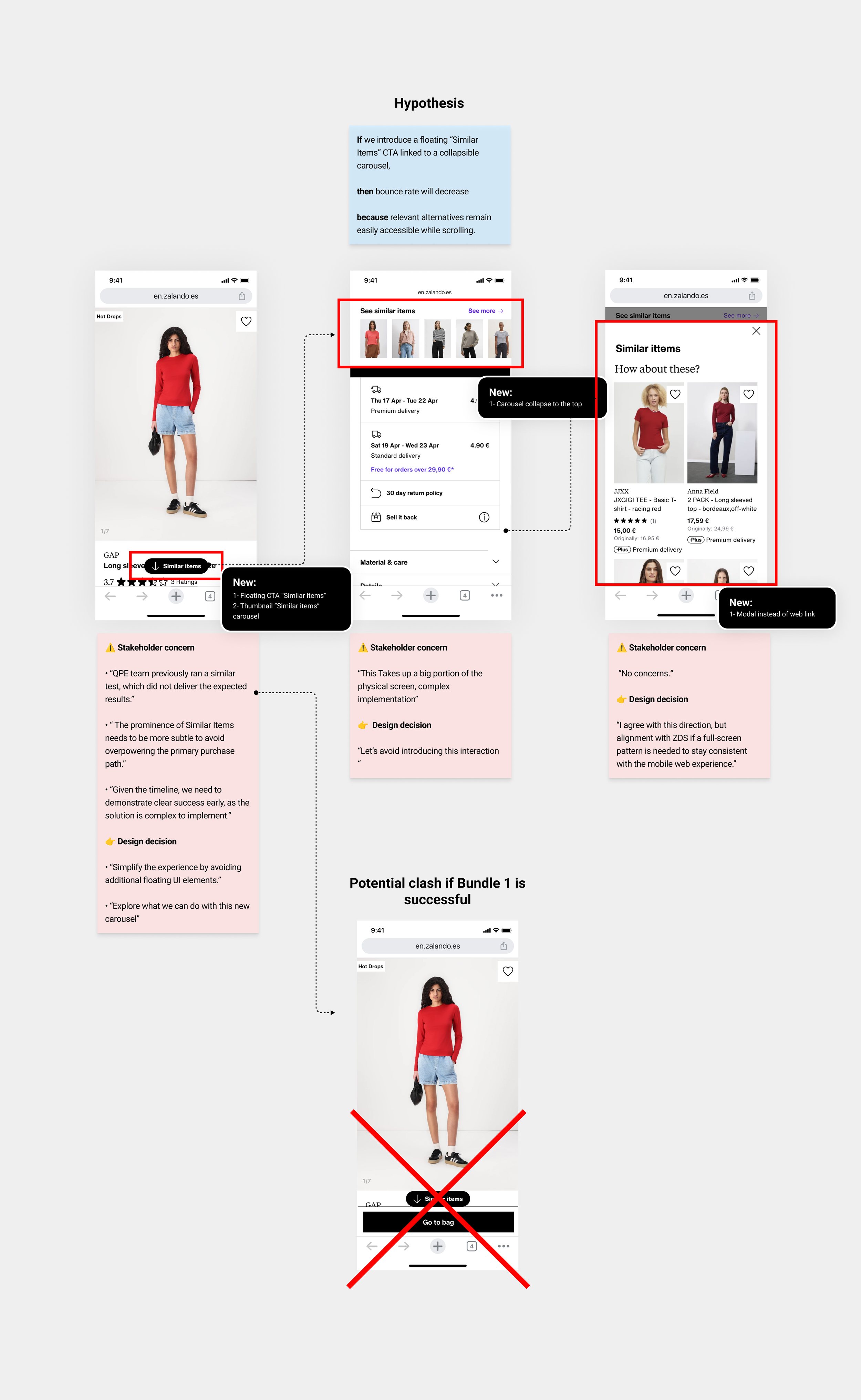
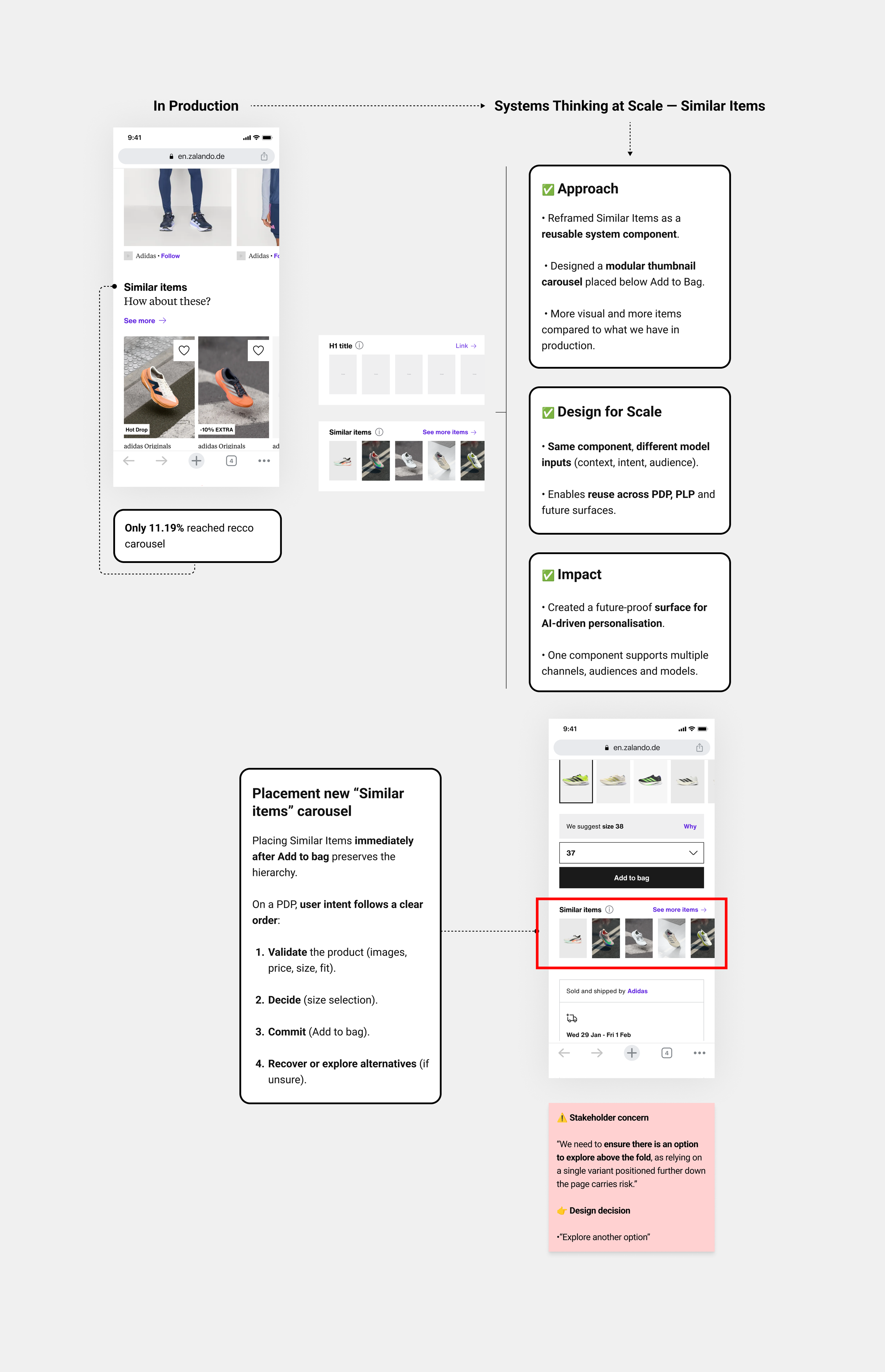
Based on the feedback, we aligned that a new thumbnail “Similar Items” carousel was a strong component to pursue. We then focused on clarifying the design thinking behind the iteration approach...
• Prototype
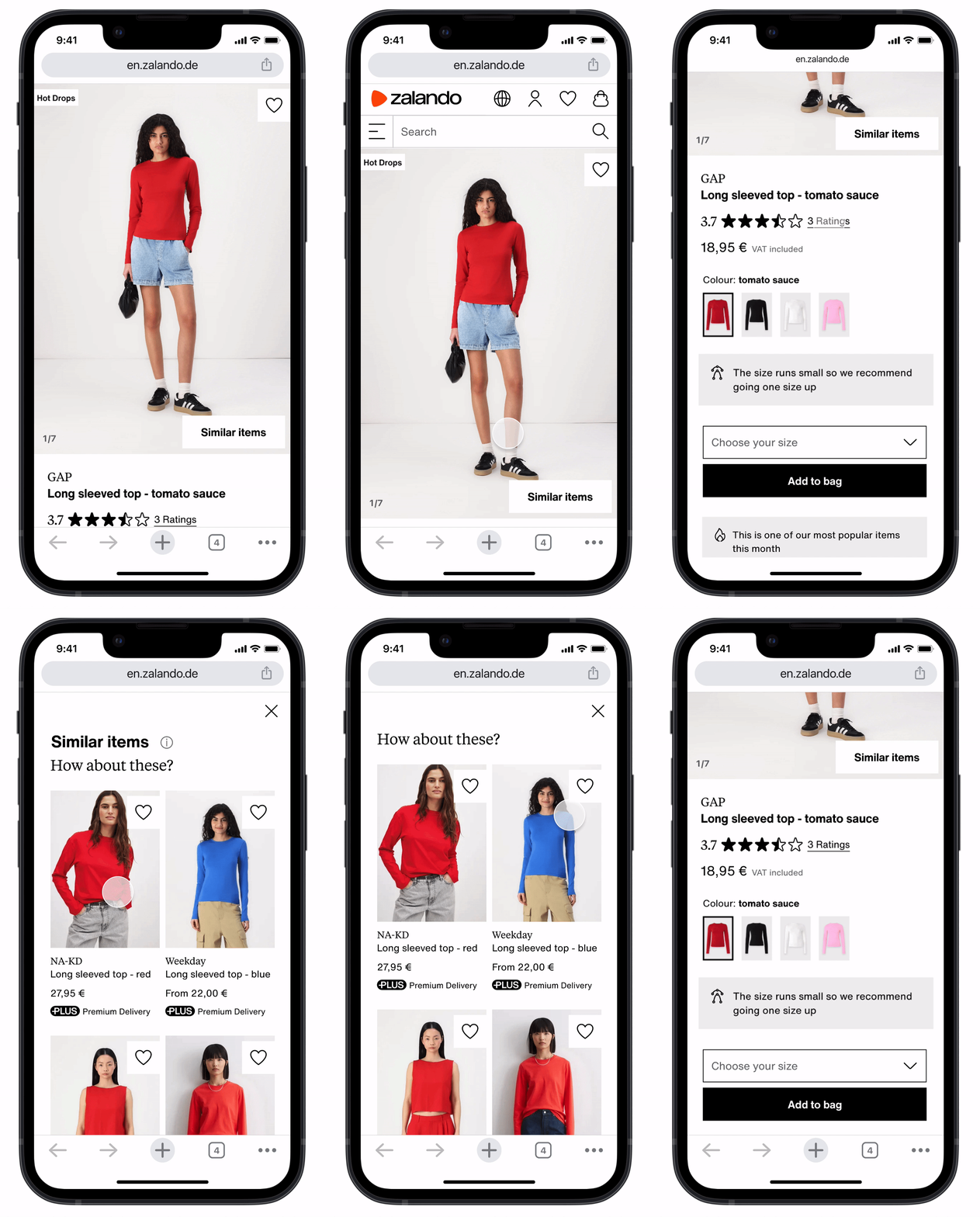
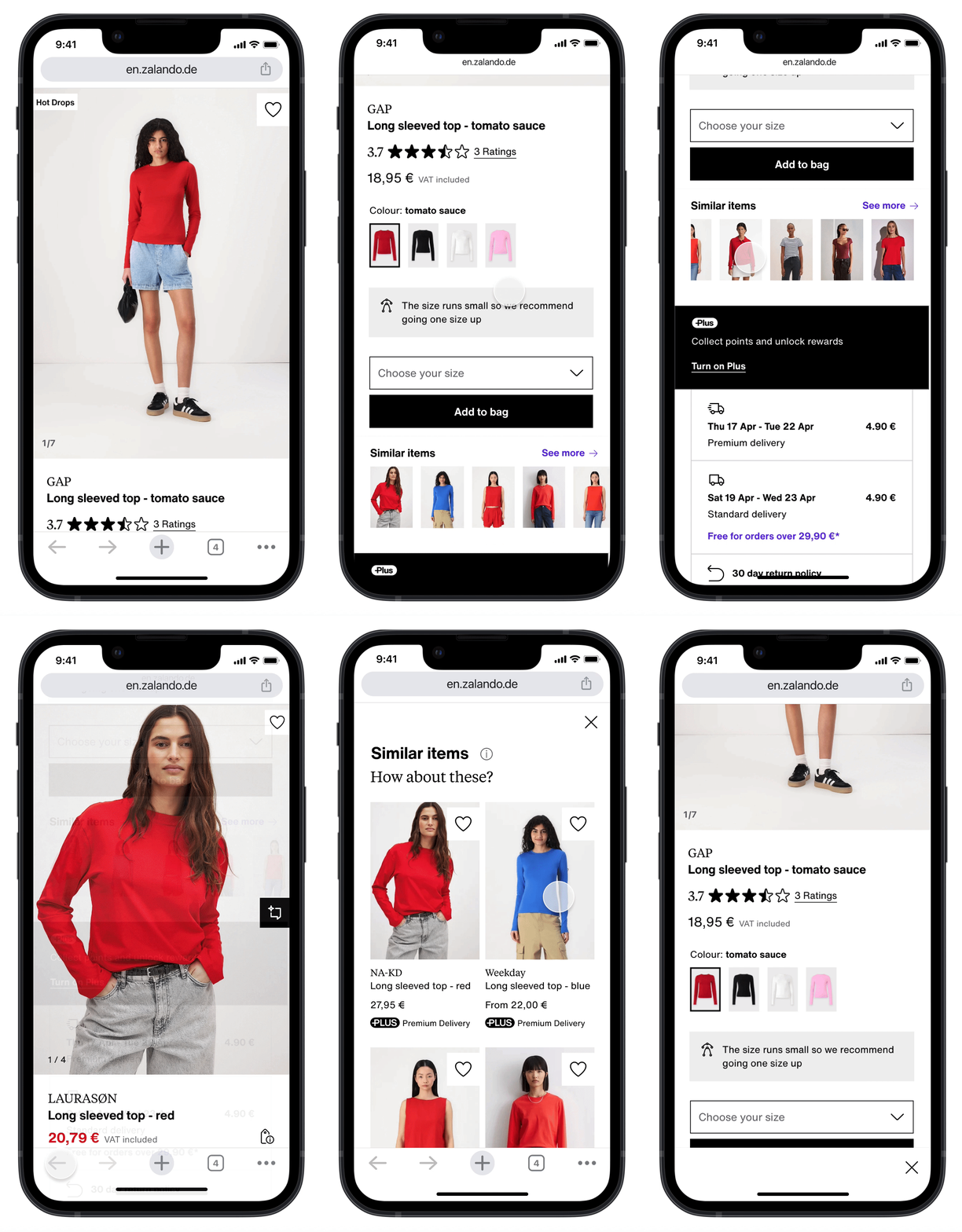
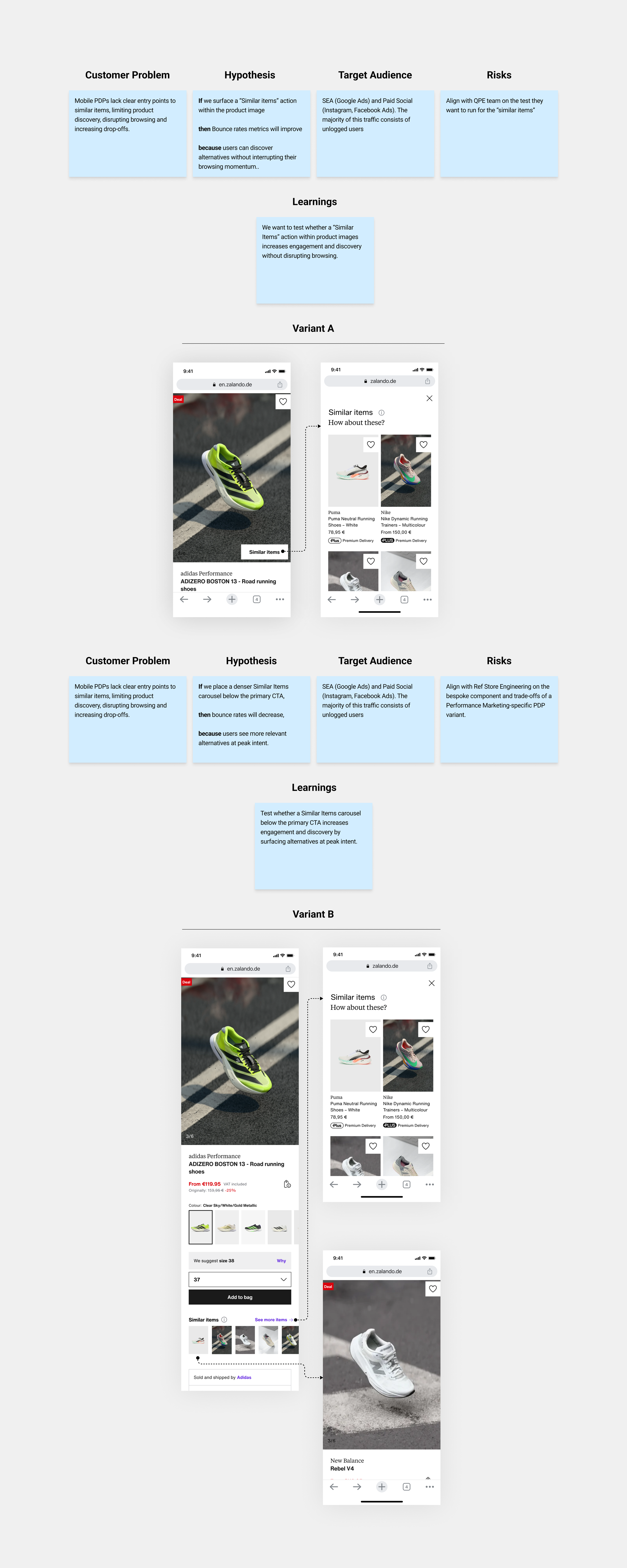
In the second iteration, I explored Variant A by placing a “Similar items” button above the fold to increase visibility and Variant B.
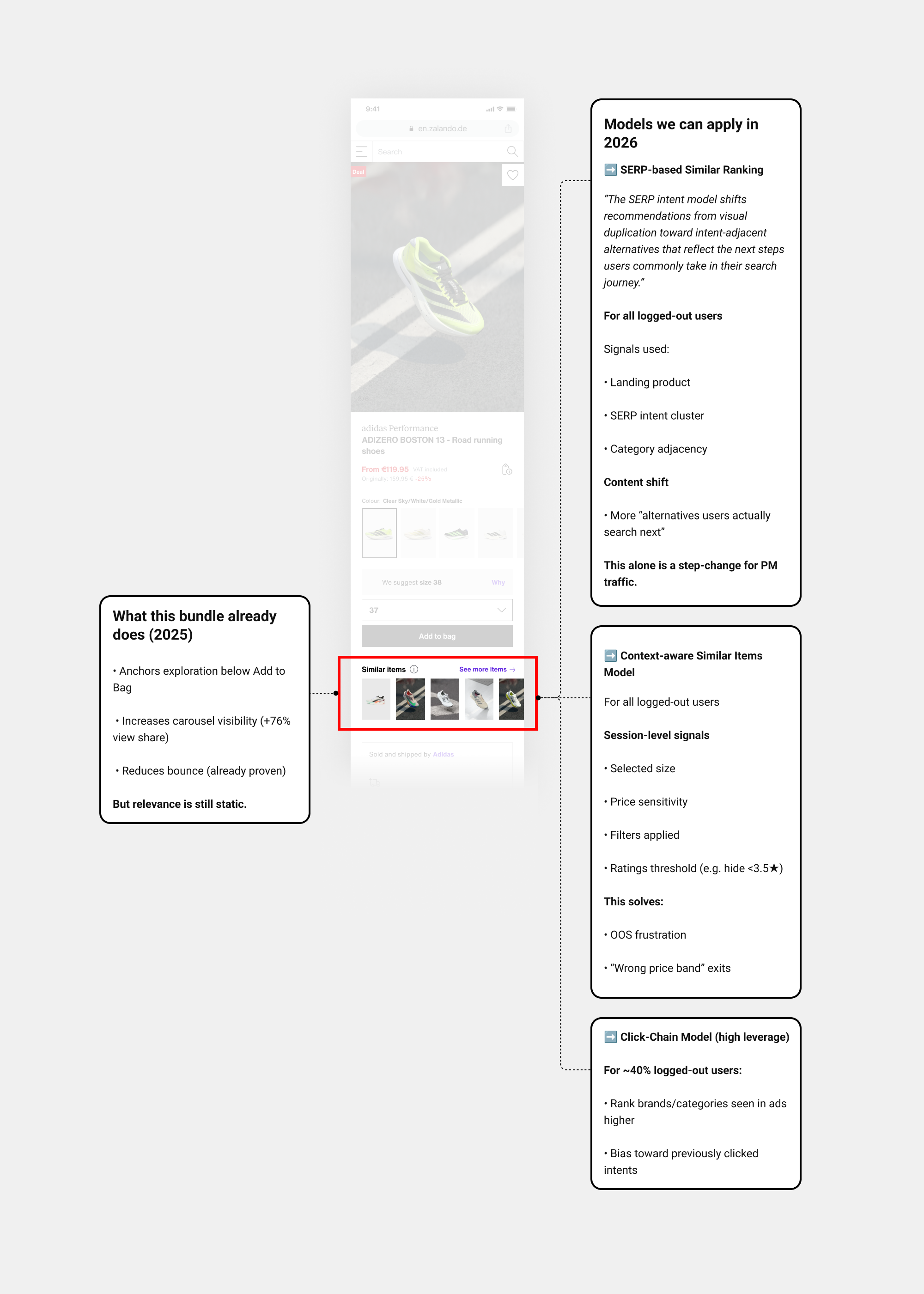
Personalisation 2026: What models can be leveraged in 2026 for Bundle 3?
I designed the Similar Items thumbnail carousel as a system-level architecture, enabling the strategic rollout of personalisation models planned for 2026 and how we can anticipate from user actions. That’s exactly how we wanted scale learning without UX debt.
• Experiment / Hypothesis-led
Given the committed business timeline and finance expectations, it was critical to launch a Similar Items test by August. This urgency helped drive alignment across teams and ensured progress toward a solution that could be tested at scale, avoiding delays and maintaining stakeholder confidence
• EPPO Results and Key insights
• 🚀 Learnings and Rollout decision
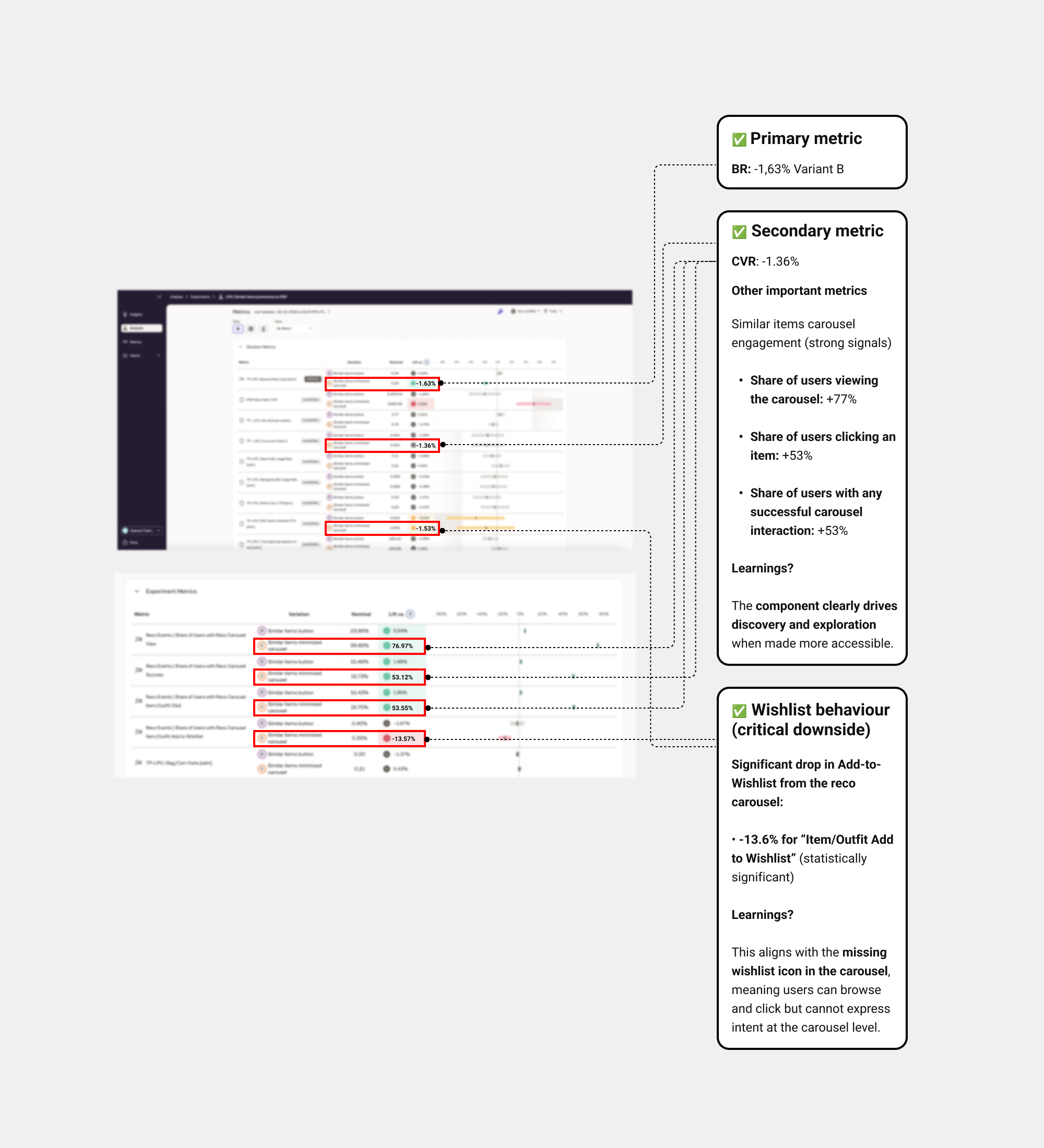
Variant B performed better, confirming that a a more visual Similar Items outperforms a text button entry point..
• BR:-1,63%
• CVR: CVR is treated as neutral / inconclusive
Rollout decision: The hypothesis was validated and we rolled out this feature to PM channel.
☝ In 2026, we will iterate on this test by adding a wishlist icon to each item in the Similar Items carousel to assess whether it increases wishlist adds both within the carousel and on the PDP overall.
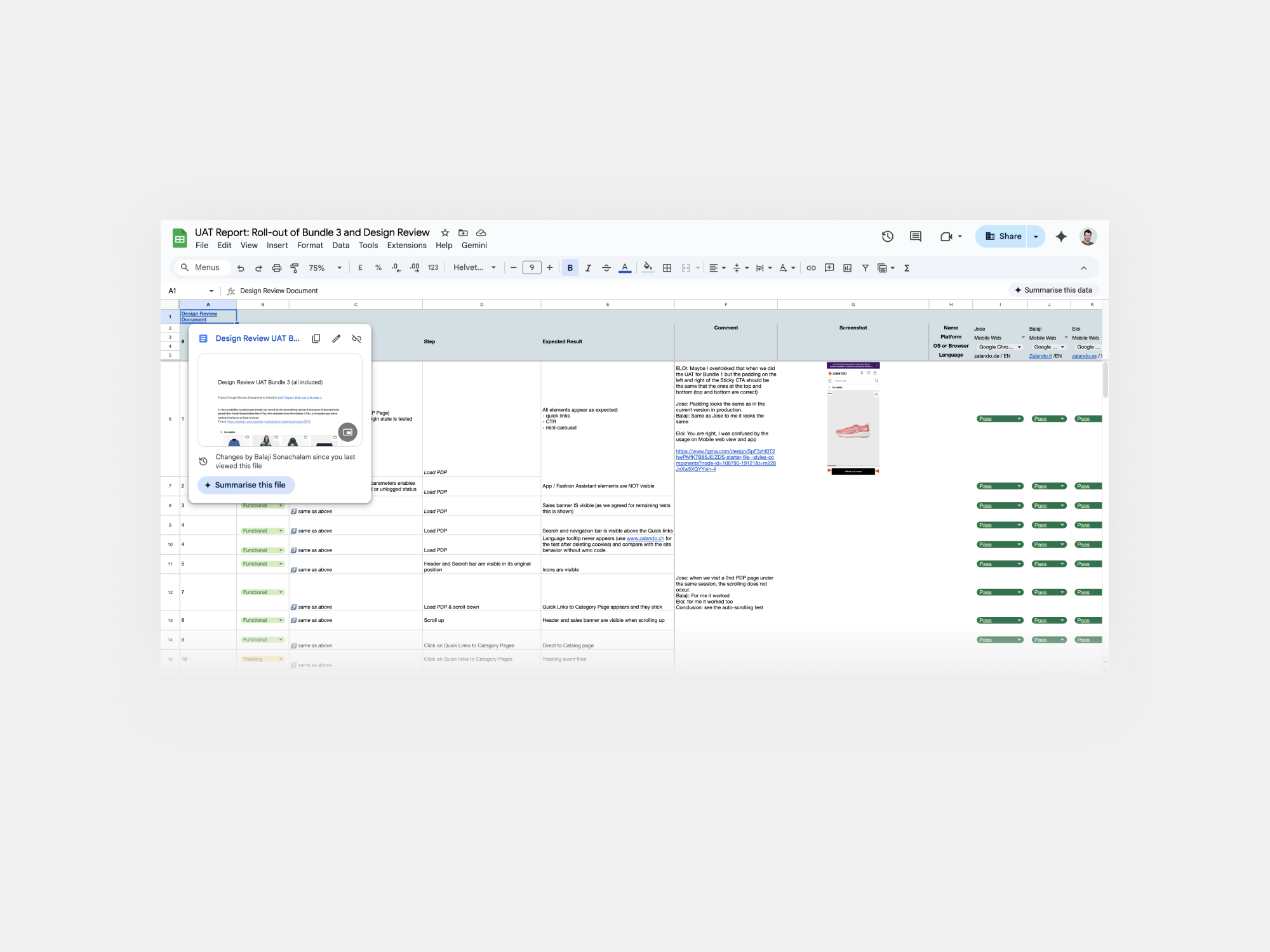
Although earlier bundles had completed UAT and design reviews, the merged rollout required broader stakeholder alignment. I led the end-to-end design review with the PM, flagging UI, functional, and accessibility issues, and thanks to prior close collaboration with engineering, most points passed, enabling a successful rollout!!
🚀 Rollout with cumulative features Bundle 1, 2, 3
Following the successful individual validation of Bundles 1–3, we advanced to a cumulative rollout, integrating them into a single, streamlined PDP experience. This enhanced experience combined Sticky Add-to-Bag, Quick Links, and the Similar Items thumbnail carousel, while removing banners and the AI assistant and prioritizing Search on page load to maximize clarity, discoverability, and end-to-end impact.
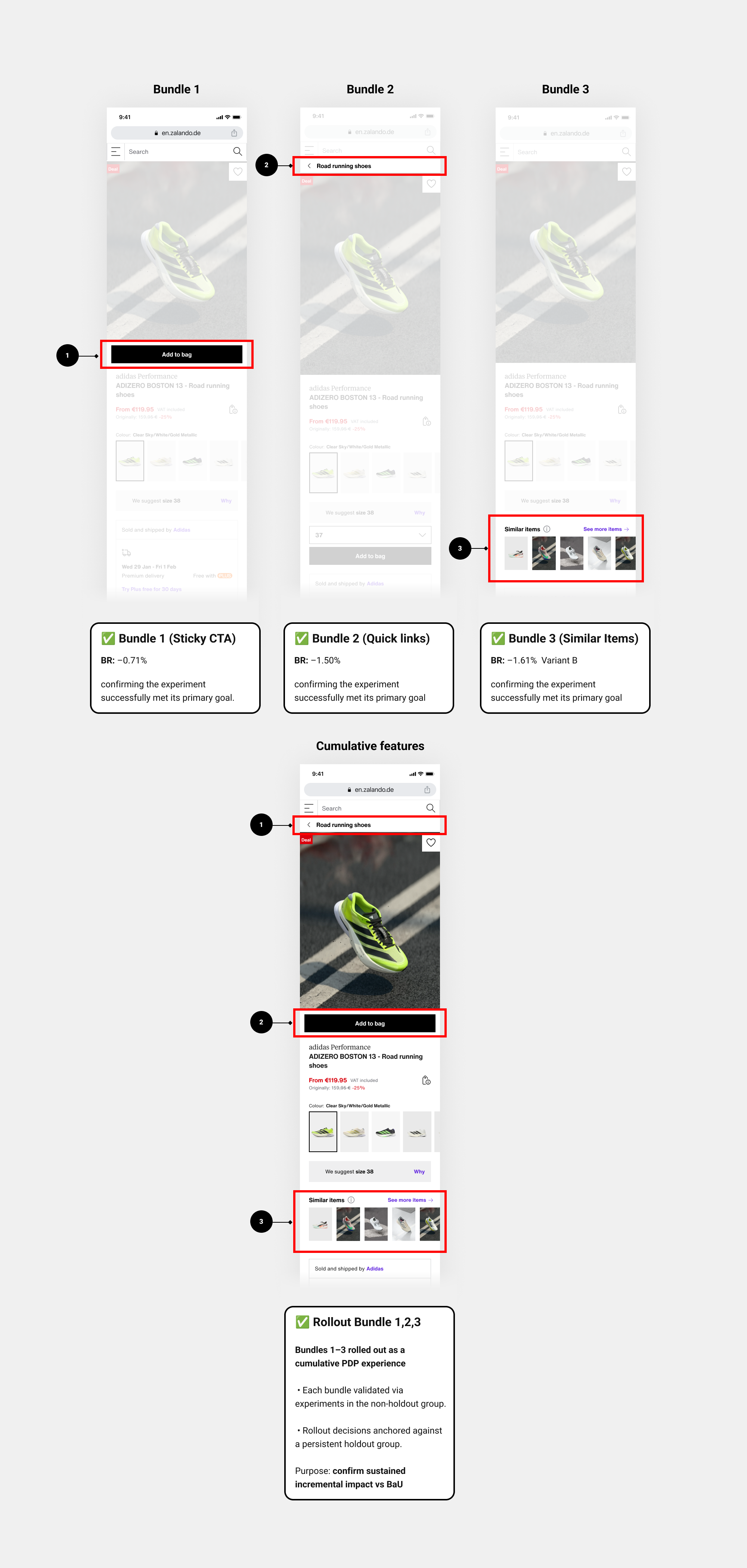
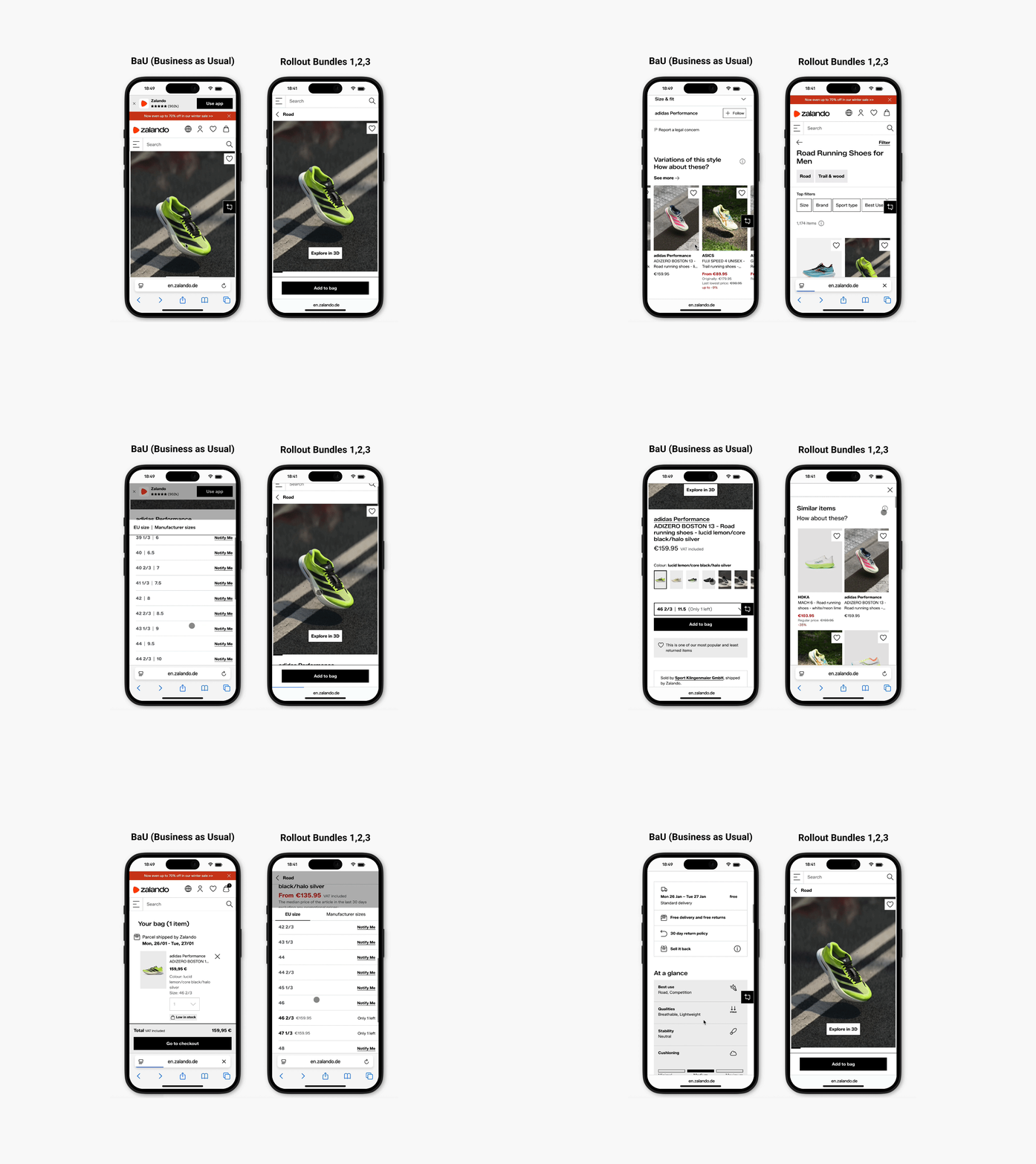
Bundles 1, 2, and 3 were rolled out as a cumulative foundation. Going forward, all validated and successful changes from these bundles will be systematically carried over into future bundles as part of the LPO roadmap.
Scaling the optimisation programme
This case study focuses on Bundles 1–3, which progressed through experimentation to rollout. Additional work across Bundles 4–6, including further optimisation concepts and experiments, is available to discuss on request.
Lessons Learned
• With tight testing deadlines at Zalando, I had to simplify how I gathered feedback from Ref Store, ZDS, and Accessibility. Their limited weekly slots meant I needed to build relationships, align asynchronously, and move quickly.
• The LPO team had no established design culture, as it was their first time working with a Product Designer. I set up processes, ways of working, clear roles, bundle strategies while delivering against strict 2025 objectives.
• Aligning with QPE (Quality Product Experience) and PRSB was a major challenge (operational risks and dependencies). Their PDP long-term visions often differed with ours (Performance marketing channel), so coordinating roadmaps while keeping LPO releases on track required constant alignment. As we progressed, the business questioned whether a single PDP for Performance Marketing was viable.
• What was really challenging is to demonstrate impact the first 3 months, we had pressure to show results, so one of the things that I learned is not to lose focus in each Bundle about the Business goals , thanks god we had good results and this Initiative LPO directly improved conversion and bounce rates on high-volume Performance Marketing PDP traffic, translating small UX gains into significant incremental GMV, making it a Priority 1 financial initiative.
• I’ve learned that tools like Figma Make, Claude Opus 4.5, and ChatGPT 5.2 are powerful for accelerating UI workflows and supporting reasoning and forecasting, when used intentionally, with a clear understanding of when and why to apply them.